
Admin Burden Report
The first study to expose the true cost of admin work that businesses could automate
Fyxer Research Team • Jan 2026
Executive Summary
The price of pencil-pushing
It’s 2026. Every organization has access to thousands of digital tools. The rollout of AI makes it easy to believe that busywork belongs in the past, buried alongside fax machines, dial-up, and Clippy the paperclip assistant.
Yet the opportunity to access AI hasn’t eliminated admin. Far from it. Repetitive, peripheral tasks still consume the workday. Reloading the printer has been replaced by scrolling through overloaded inboxes and hammering out meeting notes.
Fyxer isn’t satisfied watching admin dominate the workday. Professionals have far more to offer. That’s why we created the Admin Burden Index: a survey of 5,000 UK and US office workers that reveals how much time they spend on specific admin tasks each day, and their attitudes toward using AI to lighten the load.
The index exposes the extent of the admin burden and quantifies the silent productivity cost to UK and US organizations. The results are clear: admin is the root of performance paralysis stunting business growth.
What we found
- $954 billion wasted every year on avoidable admin across UK and US organizations.
- Employees lose 5.6 hours per week to admin that could be handled by AI.
- Email is considered the #1 time-waster. Admin overwhelm has pushed 48% of the workforce to consider leaving their role.
- Employees want AI tools, but 2 in 3 say what they have is partial, ineffective or insufficient.
Term usage note:
“Avoidable admin” and “AI-addressable admin” are used interchangeably. Both defined as the daily work tasks respondents believe could be handled by AI. Data source: OnePoll survey for Fyxer, 5,000 respondents, December 2025.
Financial Costs of the Admin Burden
$954 billion spent every year on avoidable admin
Employers are leaving solutions on the bench, with a $954 billion estimated burden cost for UK & US office workers.
The US reality: Admin costs $819 billion every year
Admin steals 66 minutes per day
That's 5.5 hours every week. The admin load is fueling the Turnover Tax: 46% of US office workers feel “overwhelmed” and 50% have considered leaving their role due to admin.
Email is the #1 time-wasting task
Reading, writing, and replying to emails is the biggest time waster. 32% of US workers cite the inbox as their top drain.
West & Southwest face highest admin load
They also report the highest levels of admin “overwhelm”. By contrast, Midwest office workers report 30% less admin pressure—though still 57 minutes per day.
Workers want AI but feel unsupported
72% feel positive about AI, but only 35% have the AI tools they need. Despite this enablement gap, 3 in 4 workers say that AI has improved how they work. The US opportunity: Employers could save $3 billion per working day on admin. Target daily tasks to turn AI confidence into performance gains. Start with email and unlock time for higher-value work.
The UK reality: Admin costs £100 billion every year
Admin drains 70 minutes per day
That's 5.7 hours every week. 57% feel "overwhelmed" by the volume and time-pressure of admin tasks, and it s driving turnover. 46% of UK workers have considered leaving their role due to admin.
Admin pressure is most acute in London
London-based employees report the highest admin time loss and 67% are overwhelmed. But they're fighting back: they're the most active AI users versus any other region.
Email is the biggest time-waster
26% of UK office workers cite reading, writing or replying to emails as their #1 time-wasting admin task.
Workers want AI, but lack the tools
75% feel positive about AI, but only 30% have the AI tools they need. Despite the gap, 74% say AI improves how they work when it's used. The UK opportunity: Employers could save £388 million per working day on admin. Target everyday time savings as a low-risk way to integrate AI. Start with email, where the admin burden is most visible and most easily reduced.
The Invisible Overhead
Routine admin tasks silently drain employee time without improving output, exposing an invisible overhead most balance sheets ignore.
Avoidable admin quietly erodes the working week
Employees lose 5.6 hours per week to admin that could be handled by AI. Email is the #1 time-waster, outranking every other admin task surveyed.
Workers spend nearly one full day every week on admin that AI could handle
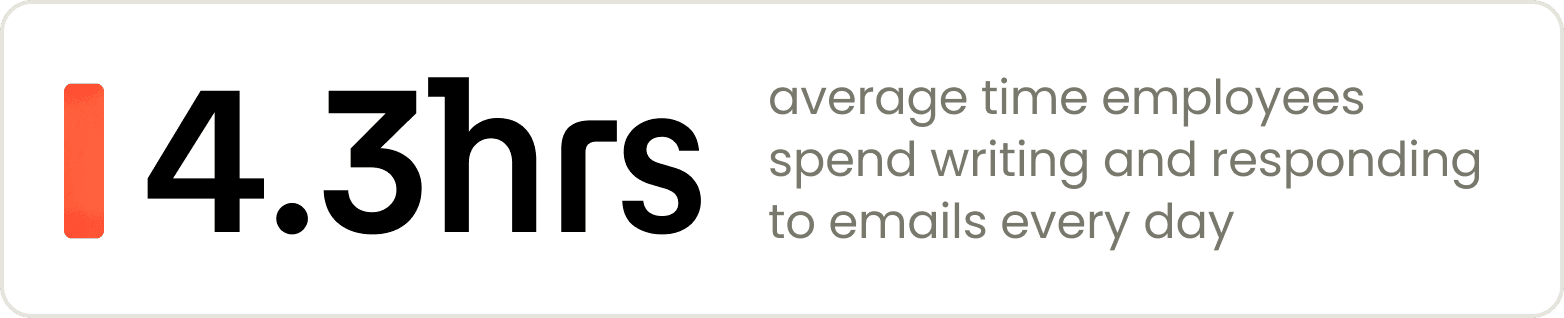
Office workers report losing 67 minutes per day to admin that could be handled by AI. That s 5.6 hours every week. Yet this is only a fraction of the problem. Looking at actual time spent on specific admin tasks reveals a structural issue: email dominates the workday, far beyond what employees currently imagine could be automated.
Email is the single biggest daily drain, multiplying the overhead
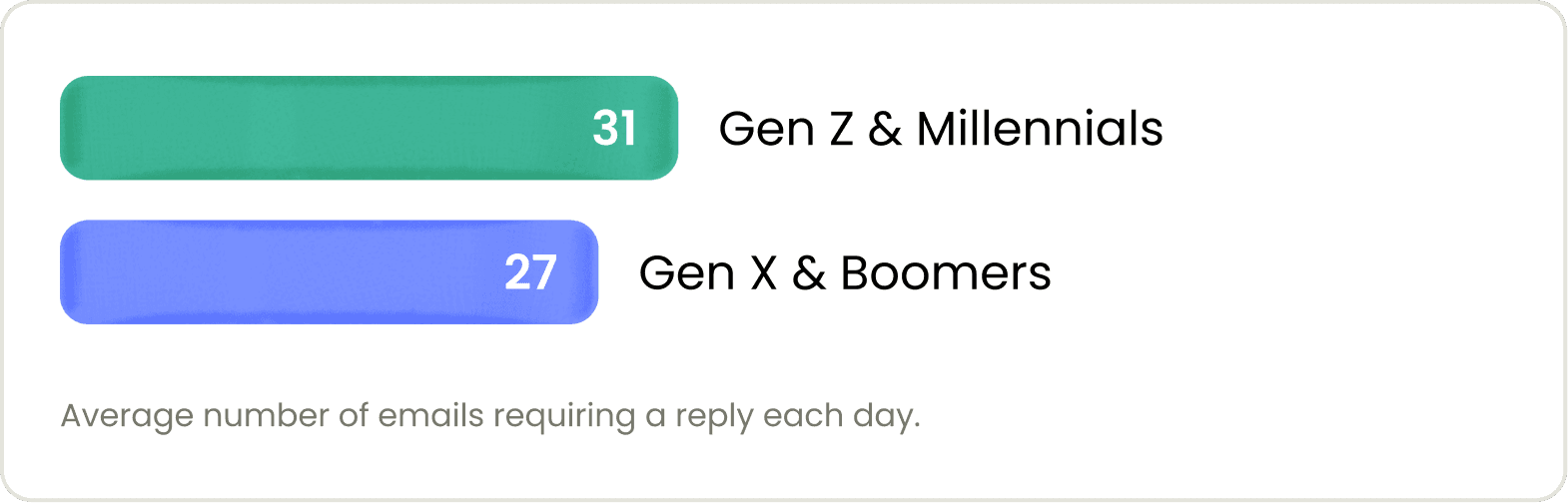
All respondents feel the pressure to reply. On average, they receive 29 emails per day that need a response. For a notable minority (15.1%), that number jumps to more than 51 emails requiring a reply.
Admin doesn't end at close of play
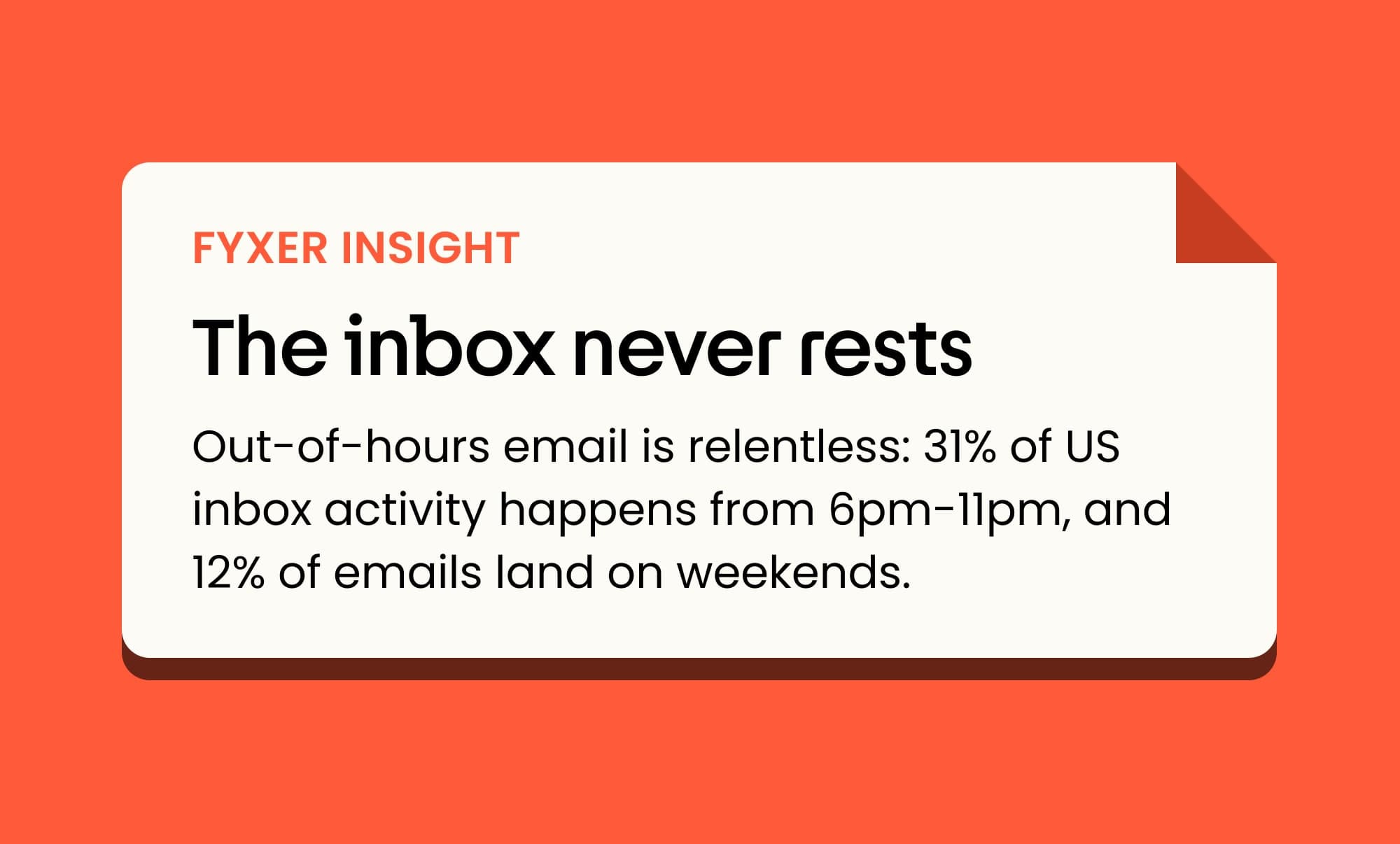
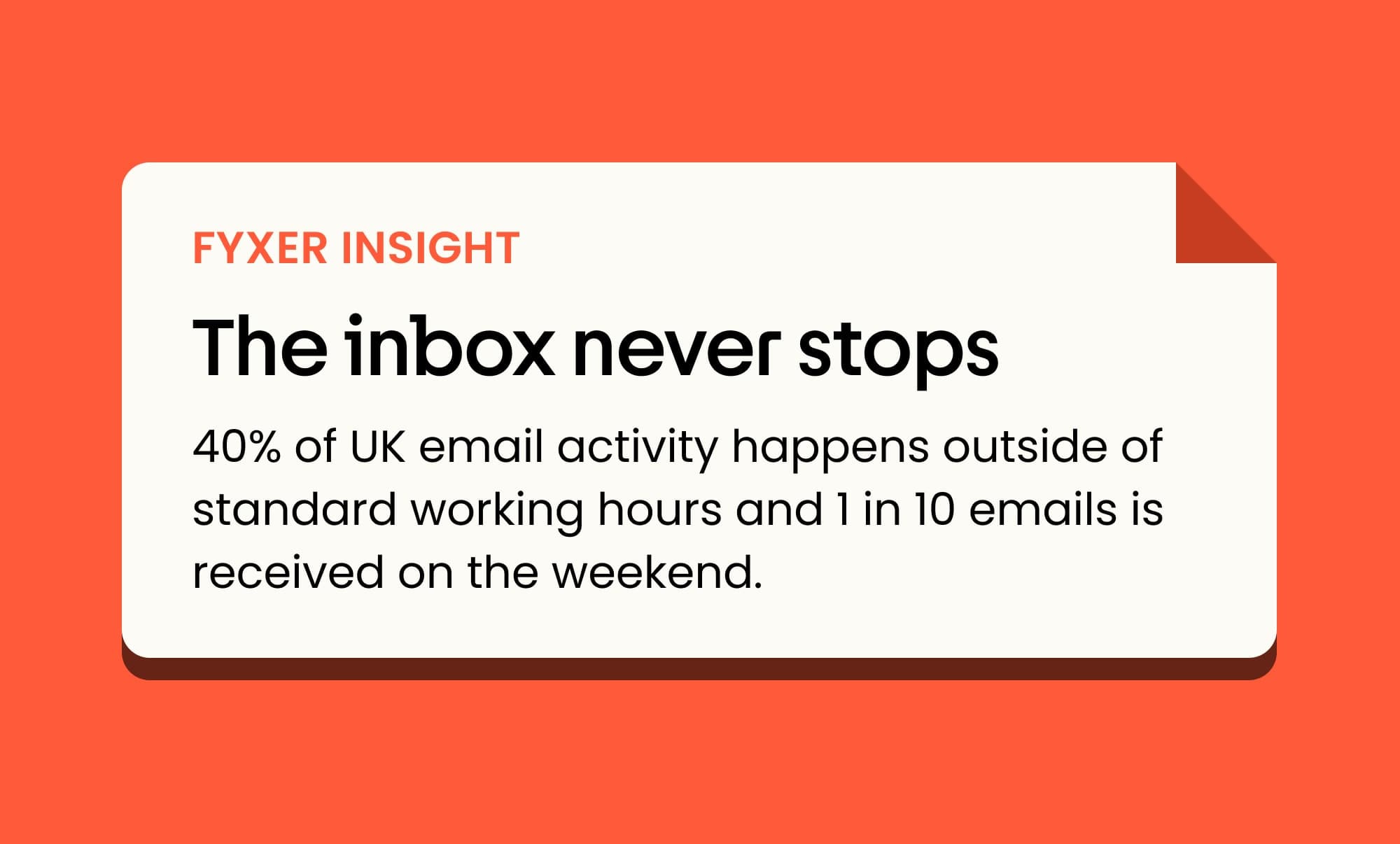
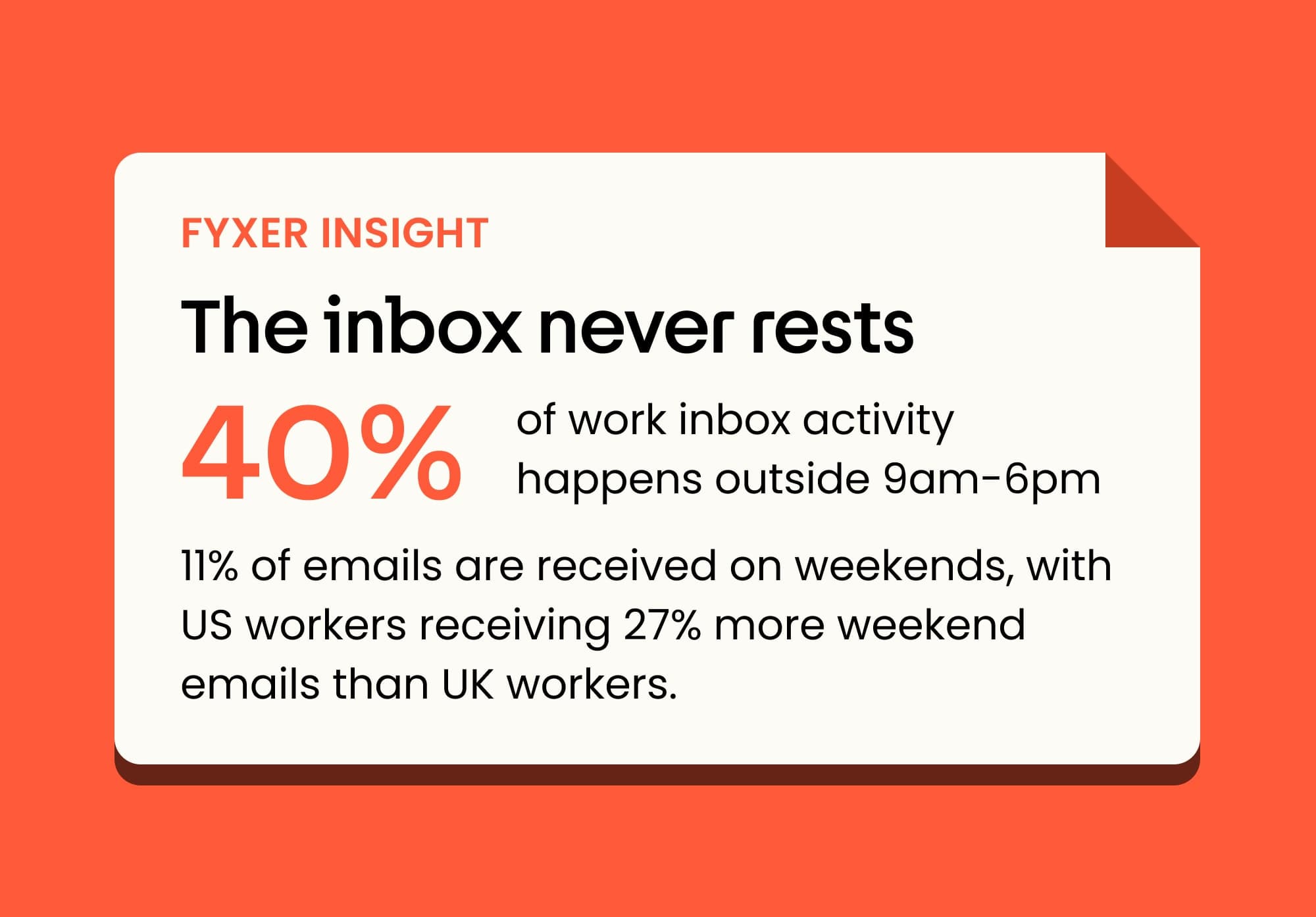
Neither does the workday for most office workers. 57% of employees work longer than their contracted hours every week. When people do work late, they average 55 minutes of overtime.
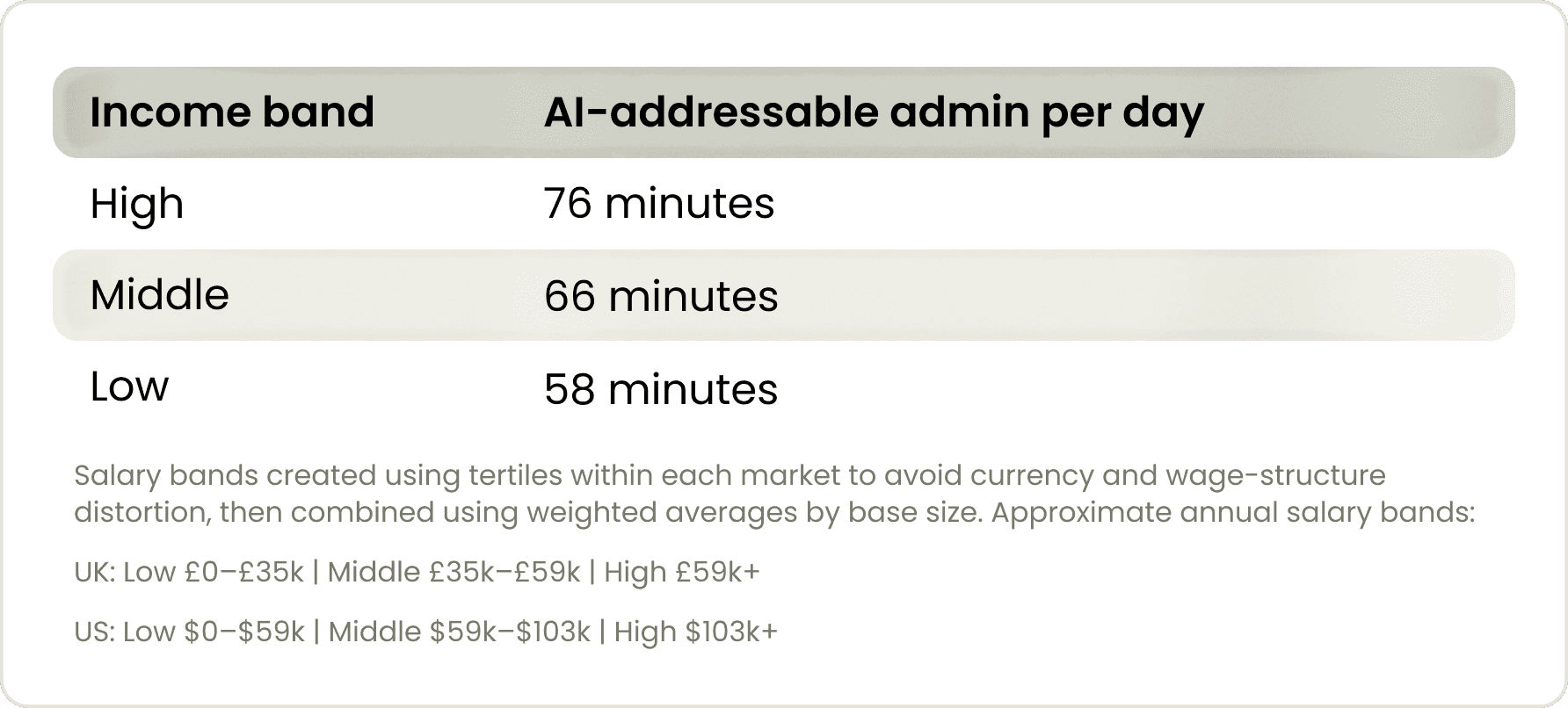
Top earners and next-gen talent face the biggest burden
The highest-paid workers are burning time on the lowest-value tasks
Admin isn’t a junior problem reserved for interns and new graduates. The admin burden scales with salary. High earners spend the longest on repetitive tasks that could otherwise be handled by AI—meaning their employers pay the steepest price for avoidable admin.
Professional and technical sectors haven’t cracked the admin problem
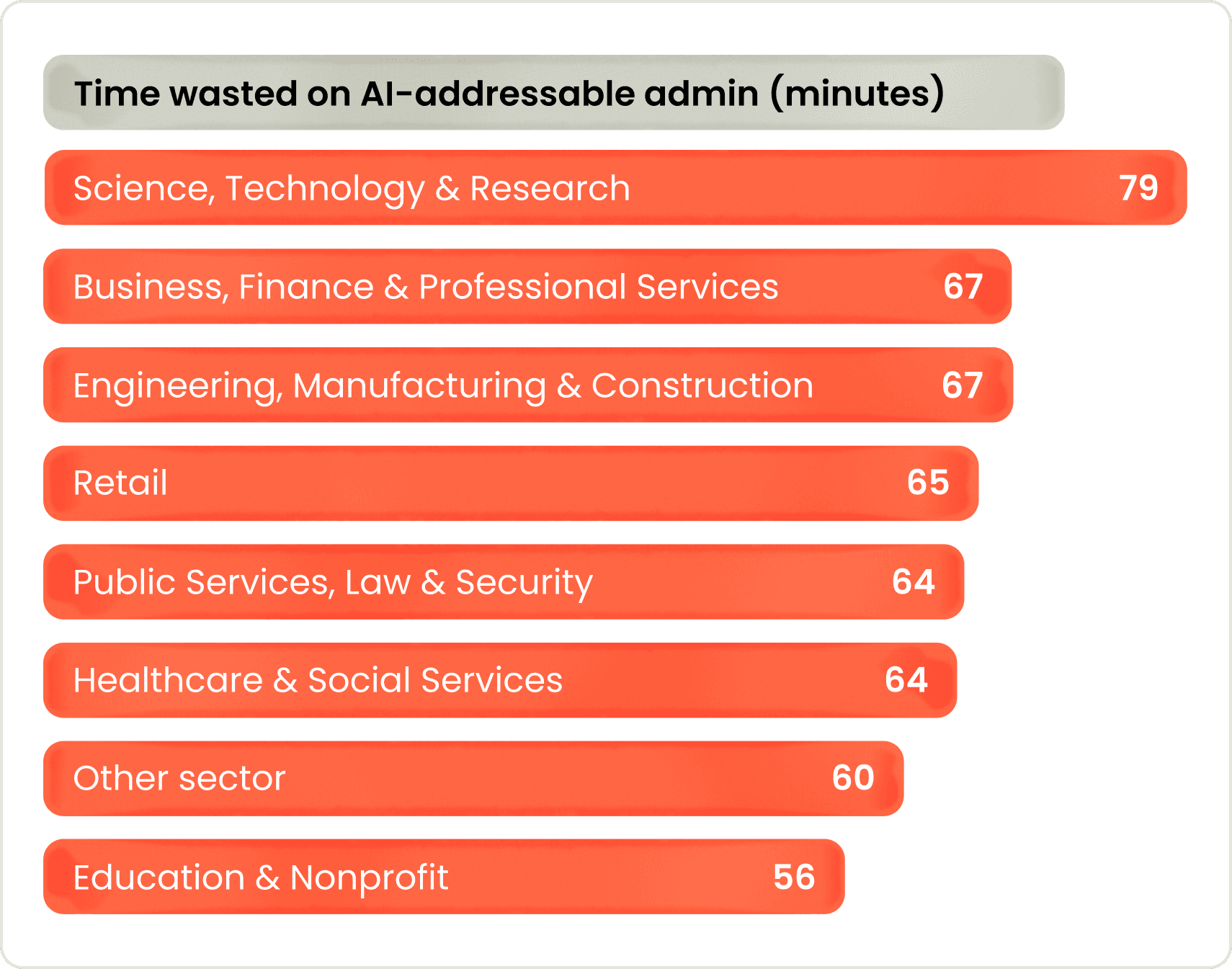
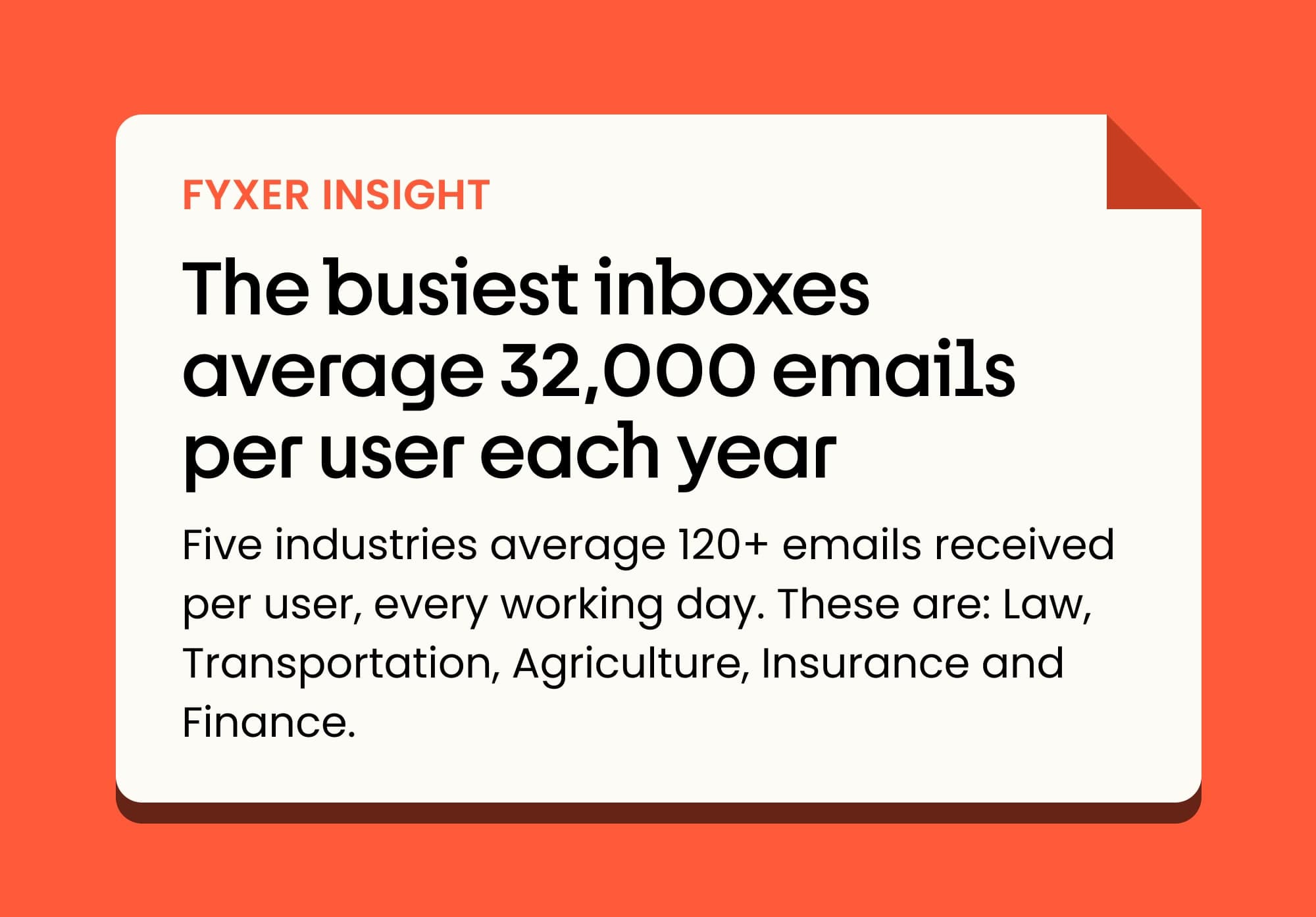
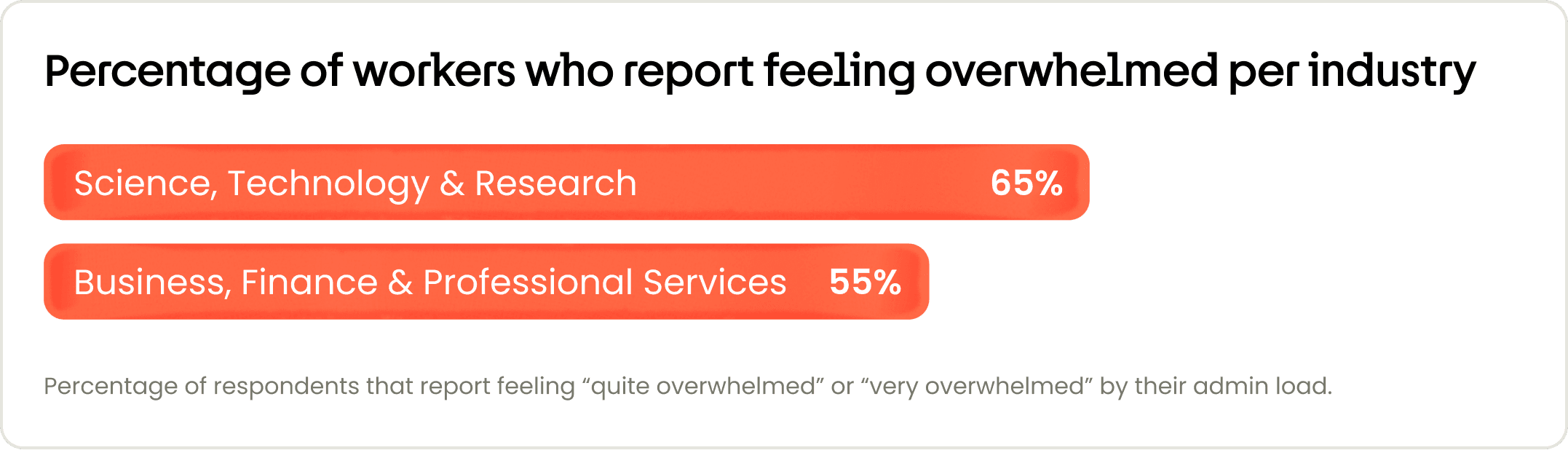
Industries wasting the most time on admin report the highest dependency on email.
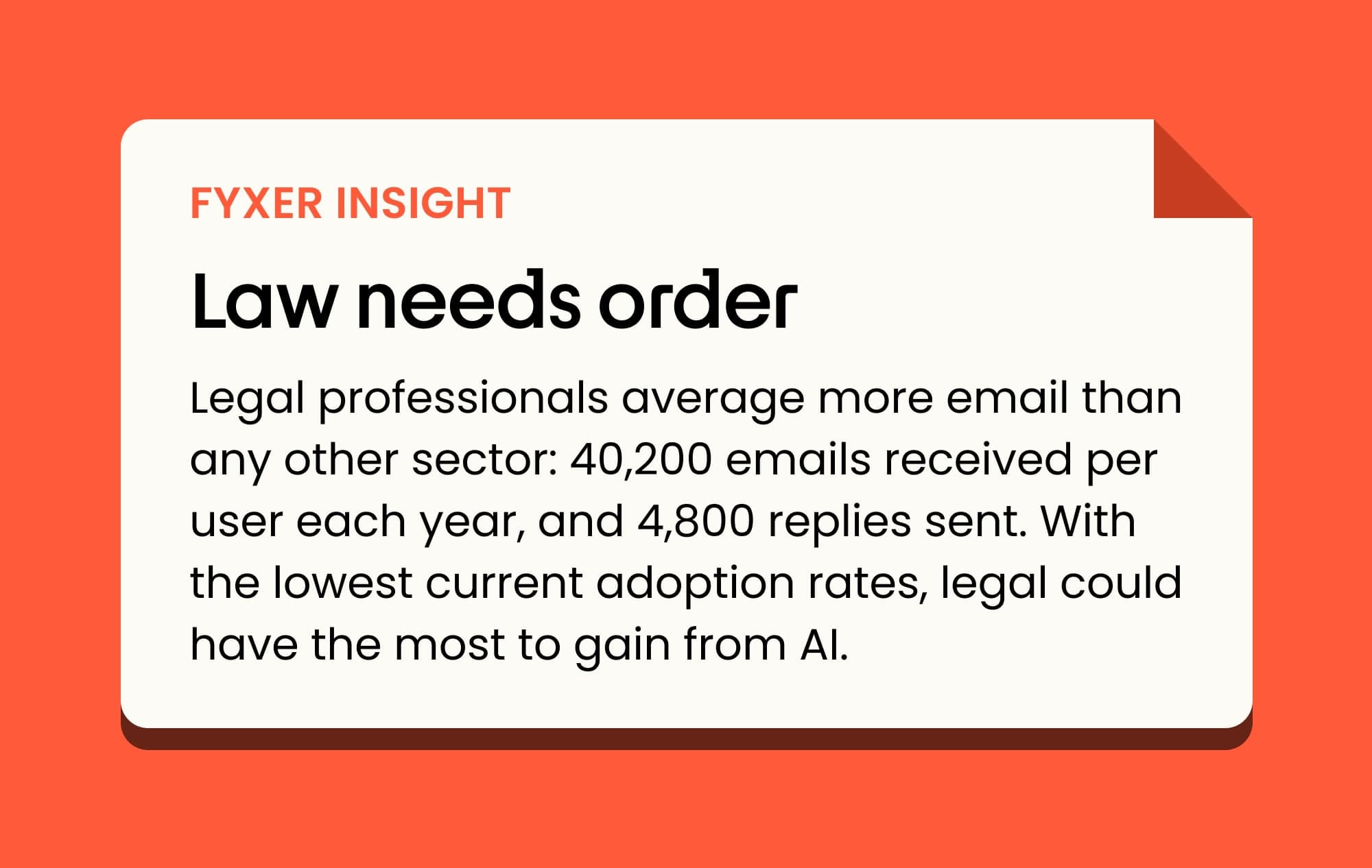
Two industries average over 4.7 hours per day in their inbox:
- Science, Technology & Research Business
- Finance & Professional Services
The heaviest admin burden falls on the youngest generations
- Millennials (29 - 44): 72 minutes
- Gen Z (under 28): 66 minutes
- Gen X (45 - 60): 63 minutes
- Boomers (61 - 80): 49 minutes
Email response pressure declines steadily with age, as does admin time
Working late is the norm for most of the workforce—except Boomers
Weekly overtime affects 56–59% of Gen Z, Millennials, and Gen X, compared with 46% of Boomers. The survey data shows why: for Boomers, the admin burden is lighter and they report spending less time on email. Data from the UK Office of National Statistics (ONS) and the US Bureau of Labor Statistics (BLS) provides the labor-market context. Older workers are significantly more likely to work part-time and/or be self-employed. Both factors lower the probability of regular overtime and increase control over working hours.
Summary: Admin blocks motivation and meaningful work
Admin displaces value-creating work
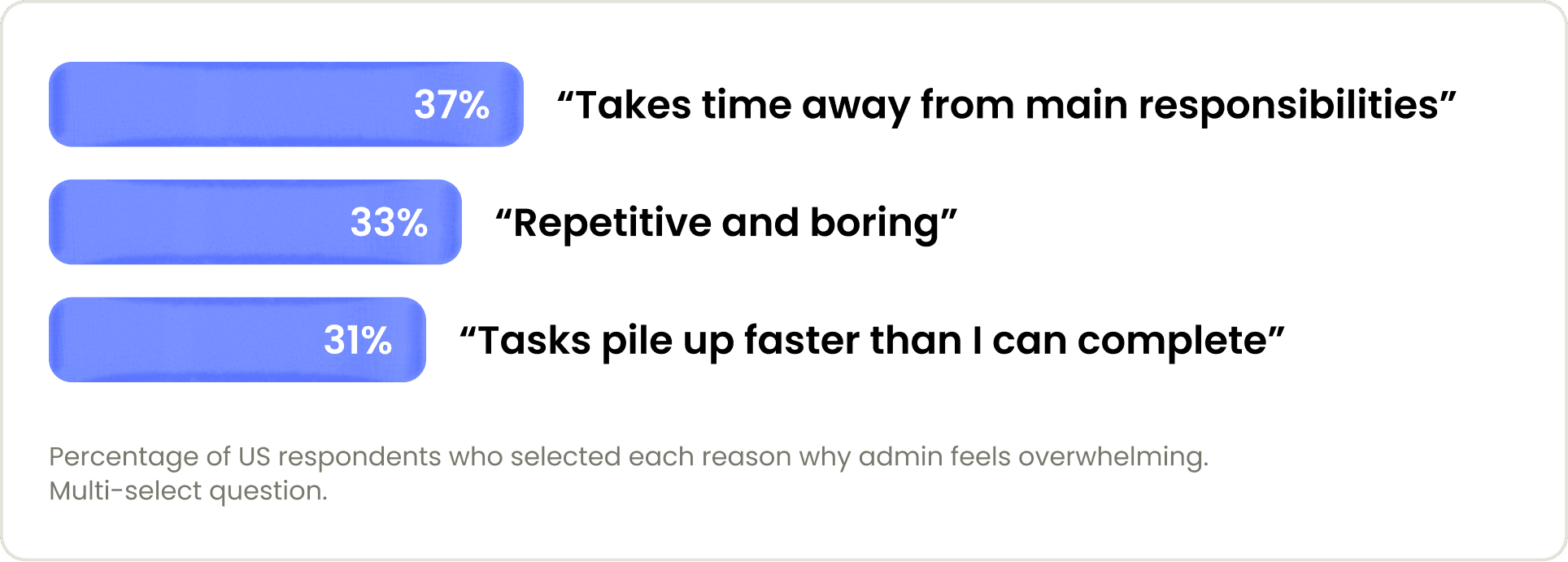
Admin is described as “taking time away from my main responsibilities” by 35% of respondents who find admin overwhelming.
Motivation drops when work feels low value
Admin is described as “repetitive and boring” by 30% and more than 1 in 4 describe it as work that “could be automated”.
Effort is disproportionate to business value
Even when work is “low-value,” people still feel quality pressure: 27% say they feel pressure to get admin tasks done “perfectly”.
Admin compounds, blocking momentum
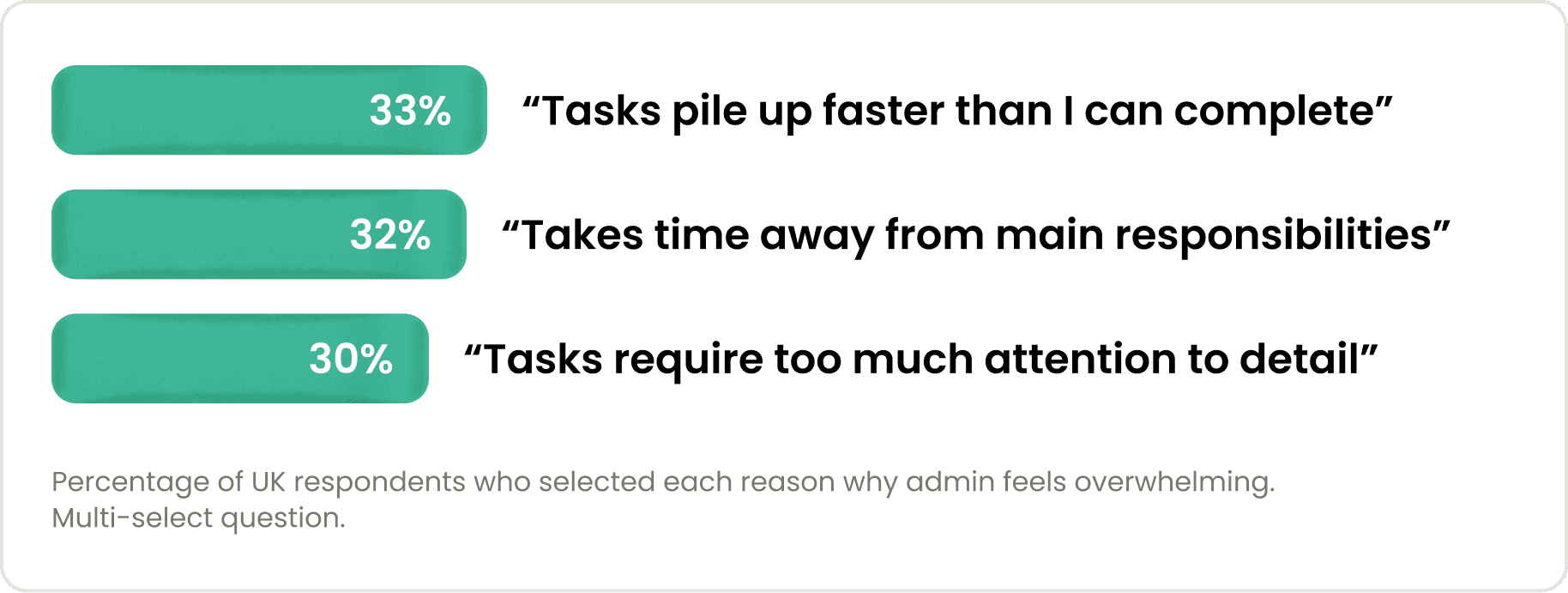
Admin isn t time-bound. 32% say tasks “pile up faster than I can complete them”. In the UK, 28% of respondents report having too many tasks to get through each day.
Context switching limits deep focus
In the US, 28% say they are constantly interrupted by admin tasks, which break focus and slow progress on important work.
Fixing the Invisible Overhead
- Measure employee admin time: Track your Admin Burden to calculate its financial impact.
- Scrap generic goals to “improve efficiency”: Instead, set quantifiable targets across your organization, such as removing 5 hours of weekly admin per employee.
- Eliminate high-frequency, repetitive tasks: Lean on proven AI tools to reduce the load.
- Treat admin reduction as a capacity unlock, not an HR side project: Invest in tools that can save time before increasing headcount.
The Turnover Tax
Admin overload is burning through employee capacity, fueling attrition risk and forcing employers to pay the turnover tax.
Admin overload drains energy and talent
Admin overwhelm has pushed 48% of the workforce to consider leaving their role, frustrated they can’t focus on what they were hired to do.
Admin is a major contributor to the increase in workload
1 in 2 respondents have seen their workload increase in the past 12 months. Of that workload increase, 29% is admin tasks. For a notable minority - 15% of office workers - more than half of their increased workload is admin.
Admin isn’t just annoying, for half of office workers it’s reached “overwhelming”
The UK reports a higher emotional burden caused by admin, tracking 11 percentage points higher on “overwhelm” than the US.
- UK: 57% overwhelmed, including 12% very overwhelmed.
- US: 46% overwhelmed, including 9% very overwhelmed.
UK workers are swamped by admin volume and the need to get details right; US workers are frustrated that low-value tasks distract from meaningful work.
The UK overwhelm drivers
The US overwhelm drivers
Emotional erosion is a retention risk
The UK reports higher rates of admin overwhelm, impacting immediate performance, while the US data signals the destructive downstream impact of admin — employee turnover. 50% of US respondents say they have considered leaving their role because of admin overload vs 46% of UK respondents.
Email is viewed as the biggest friction for US workers
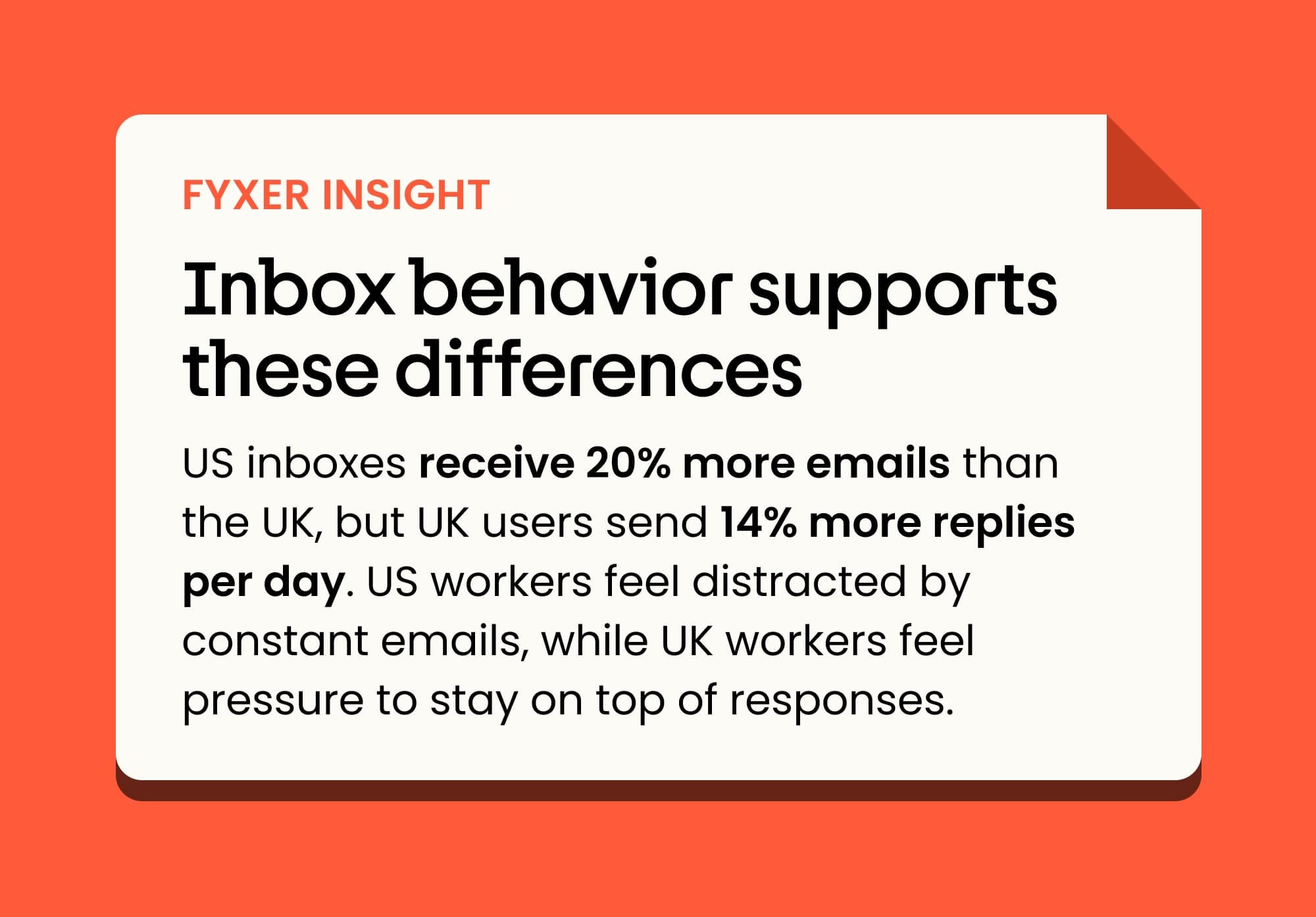
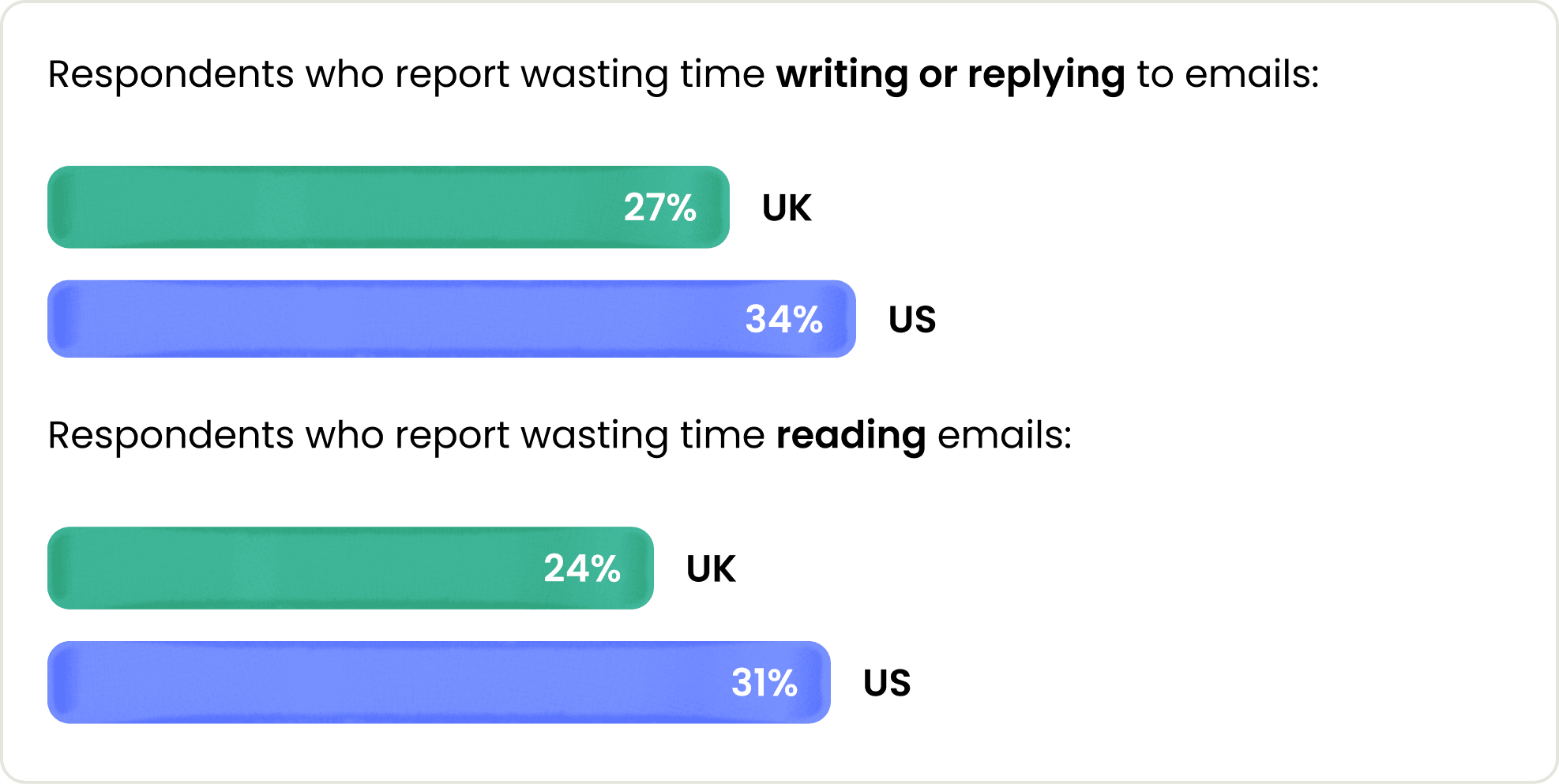
Email dominates as a weekly time-waster in both markets, but US respondents are 7 percentage points more likely than UK respondents to report wasting time reading, writing or replying to emails.
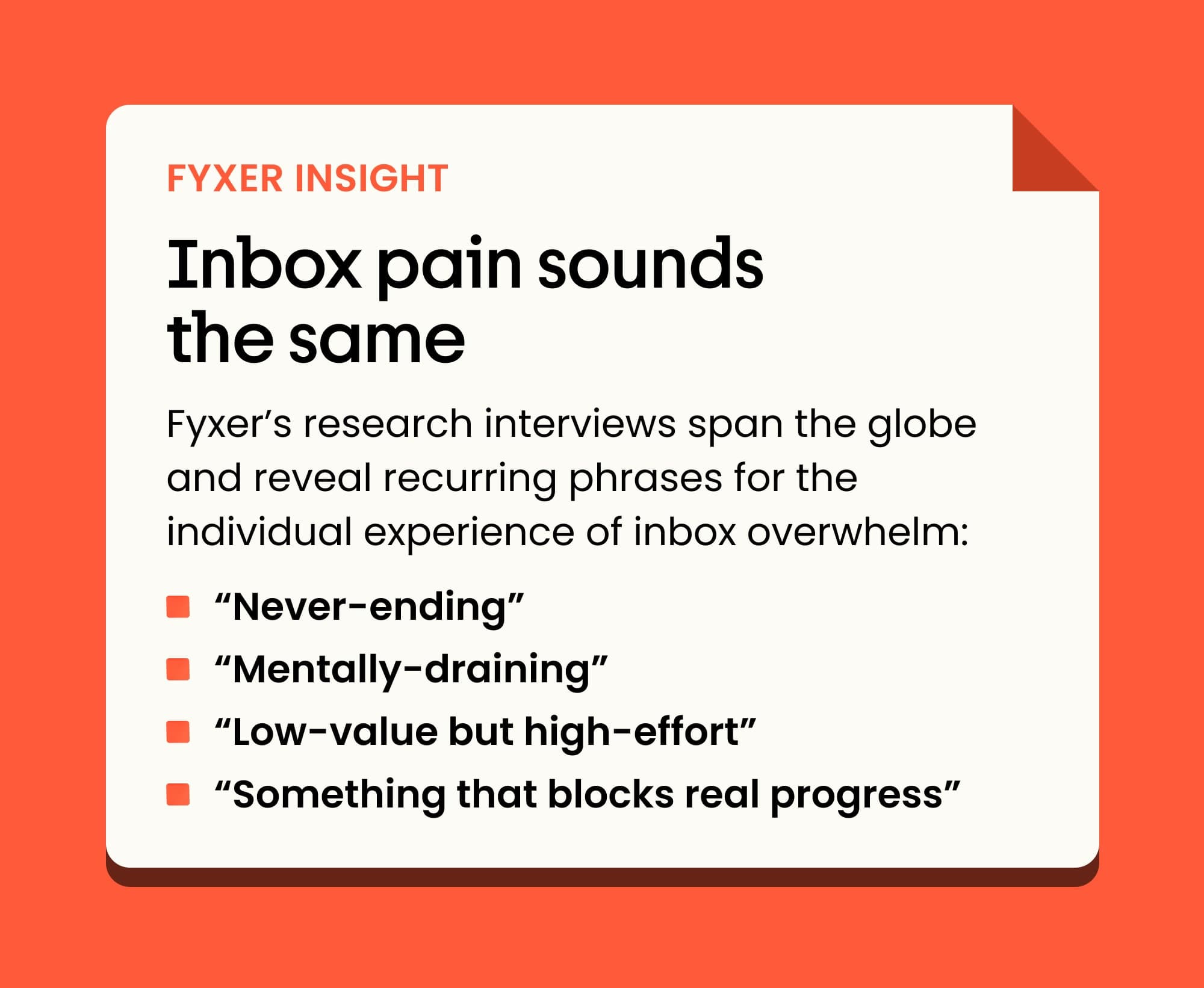
The workers drowning in admin are the hardest to replace
High skill, "frontier" industries are still dominated by admin
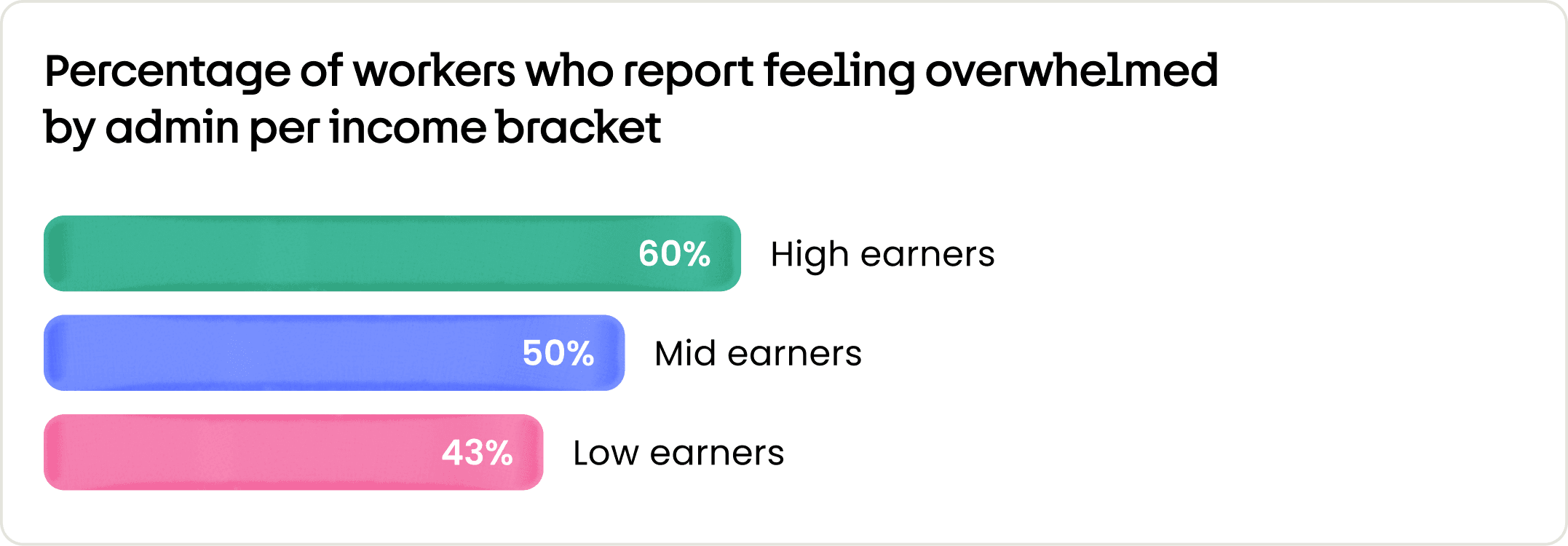
Admin overwhelm rises with income
The emotional admin burden only intensifies as pay increases, with higher-earners more likely to experience admin overwhelm.
Gen Z and Millennials feel more overwhelmed by admin than Boomers
The US and UK show the same generational gradient; the younger the cohort, the more likely they are to feel overwhelmed. Gen Z and Millennials are more than 2x more likely than Boomers to label their admin load “overwhelming”.
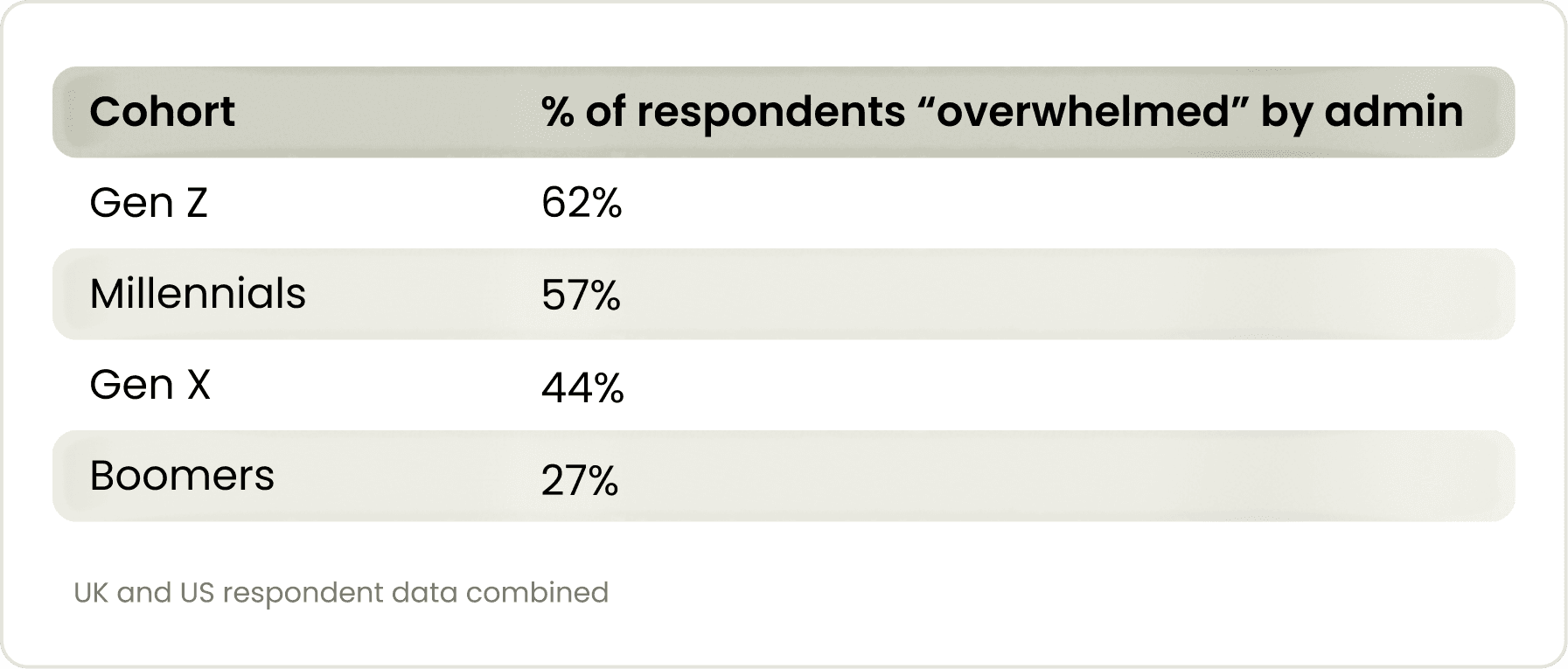
This isn't a story about younger workers lacking resilience. The pattern of overwhelm matches actual workload. Gen Z and Millennials report greater time wasted on admin and a heavier email reply burden - meaning the generational difference isn’t just perception, it correlates with measurable task load. Older cohorts report lower levels of overwhelm, in response to lower admin time waste, lower daily email time, and faster handling of email replies.
Summary: Admin overload erodes morale and retention
Increased effort doesn’t equal output
Organizations are demanding more from employees without reaping results. Even as workloads rise for the majority of employees, a substantial share of it is admin—absorbing time and energy that could otherwise drive innovation or customer impact.
Negative employee sentiment raises the turnover risk
Among those whose workload has increased, 1 in 5 employees report feeling more negative toward their employer due to the increase. With nearly half of employees considering leaving due to the admin burden, low morale has become a turnover and talent-retention risk.
Both high-earners and younger generations are raising the red flag
For employers, this creates a dual retention risk: losing experienced senior talent, who are harder to replace, and failing to meet the expectations of younger employees who represent the next 30-40 years of the workforce.
Employees are actively looking for solutions to tackle admin
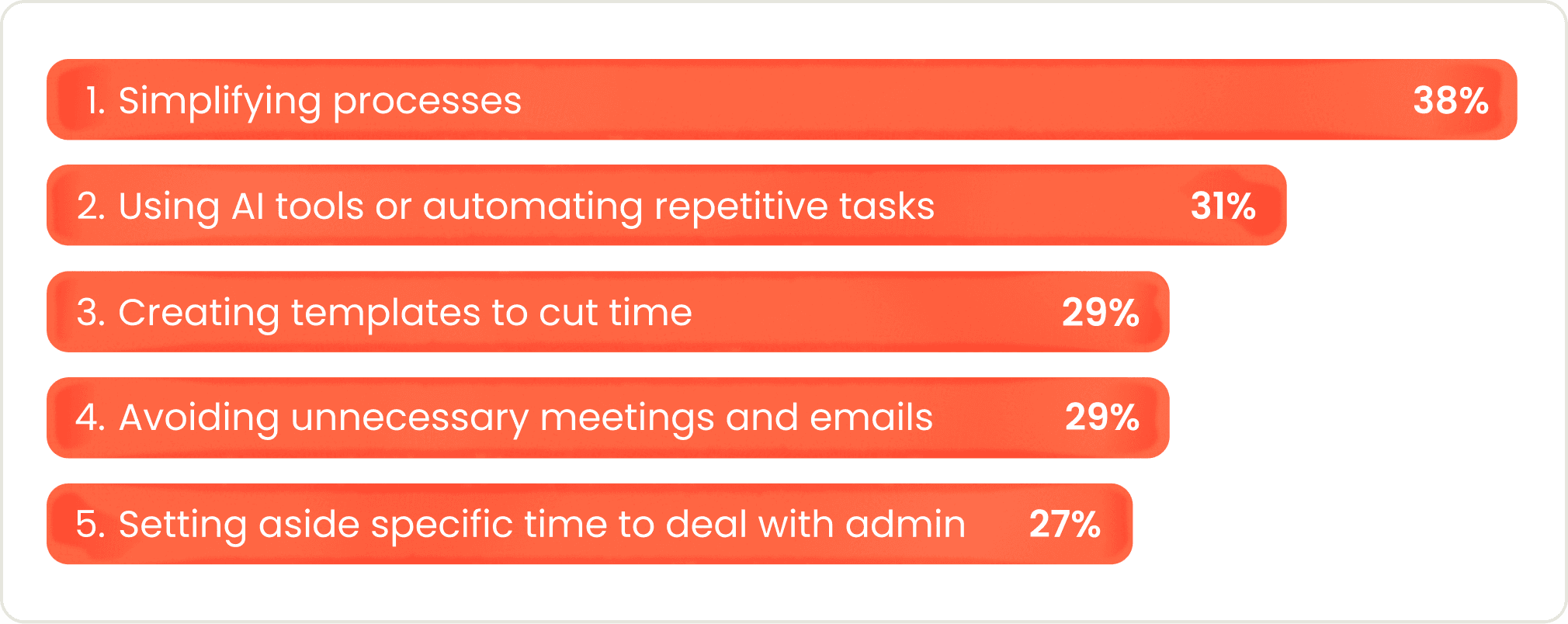
Employees aren’t waiting to be rescued, they’re already actively looking for ways to manage their admin burden, with nearly 1 in 3 turning to AI for support.
Top five ways office workers are reducing their admin load
Fixing the Turnover Tax
- Treat admin reduction as a productivity intervention: This isn’t a well-being afterthought. Turnover has a cost and retention pays back..
- Stop relying on employee resilience: The workforce should not be expected to self-manage the admin burden.
- Meet employees where they are: Scale what they’re attempting by testing new AI tools that have a proven track record of reducing admin.
- Communicate admin reduction as a priority: This is a visible signal that the organization trusts its people and respects their time.
The Performance Deficit
The gap between what employees could achieve with AI and what they're delivering today reveals a performance deficit most employers aren’t addressing.
The AI enablement gap
Employees want AI tools, but 2 in 3 say what they have is partial, ineffective or insufficient. Employer hesitation compounds the avoidable admin burden, costing UK and US employers over $954 billion annually. That’s an average of $17,000 per office worker every year.
Employees believe in AI, but adoption rates lag behind
Employees believe 67 minutes per day could be handled by AI. Positive sentiment toward AI sits at 73% across respondents, but only 41% use AI tools regularly. Where AI is being used the benefits are clear.
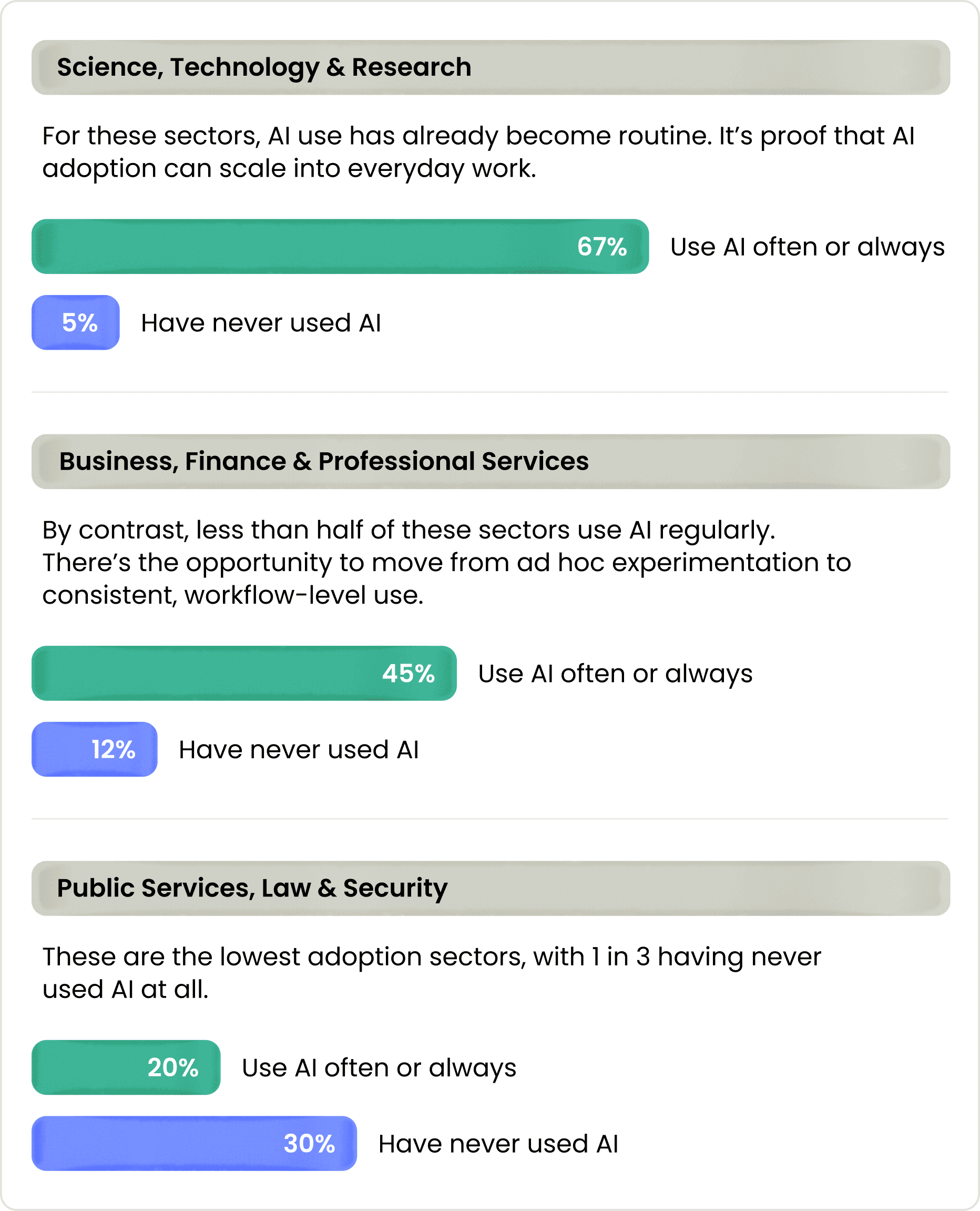
Within science, technology & research AI use has already become routine. It’s proof that AI adoption can scale into everyday work. By contrast, less than half of those in business, finance & professional services use AI regularly. There’s the opportunity to move from ad hoc experimentation to consistent, workflow-level use. Within public services, law & security, AI adoption is at its lowest. 1 in 3 have never used AI at all.
Workers aren't scared of AI taking their jobs—they're frustrated they can't access it
Just 5% express concerns about job replacement. Despite the popular rhetoric surrounding employee-AI fears, the reality is a lack of effective tools to bridge the gap between their increasing workload and the tasks that AI could handle.
Employer enablement is the primary bottleneck
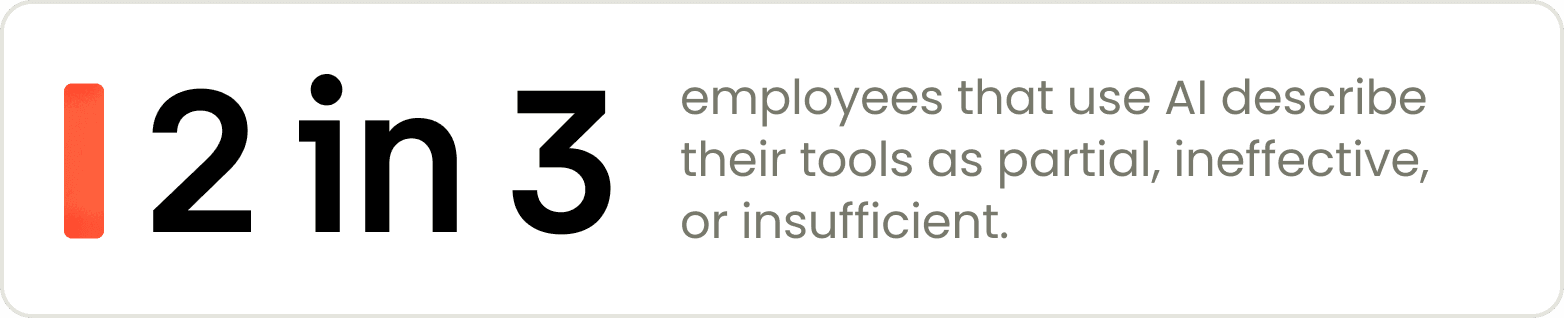
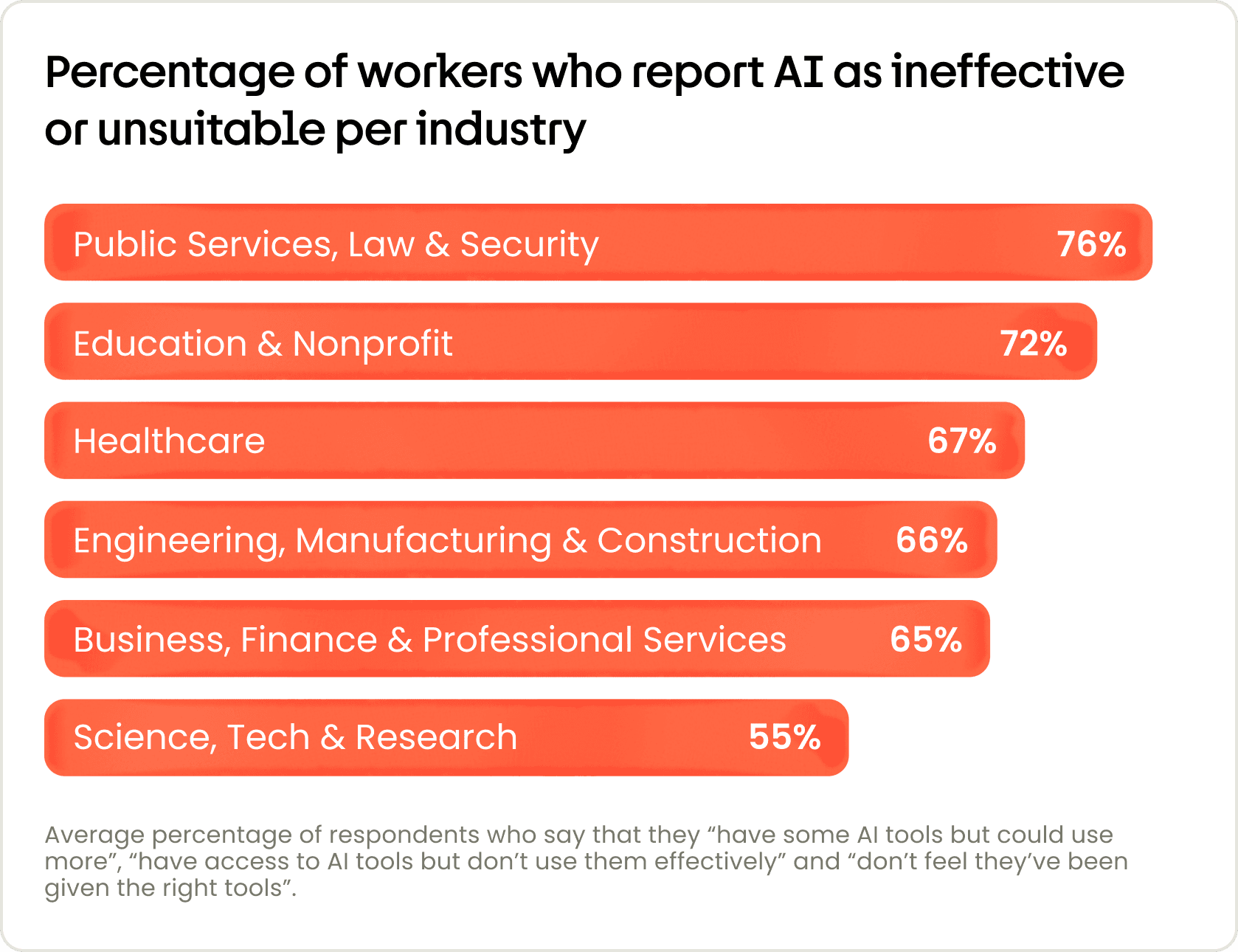
Despite strong employee belief in AI, most workers say the tools provided by their employer prevent AI from becoming part of everyday work. That makes the Performance Deficit an AI-enablement problem. This theme runs across every major industry. Unsurprisingly, it’s most acute in public and frontline sectors. But even within professional and technical industries, over 50% of respondents say they’re lacking the AI tools they need.
AI tools are considered insufficient, ineffective or unsuitable across industries
Where AI is being used, it delivers results
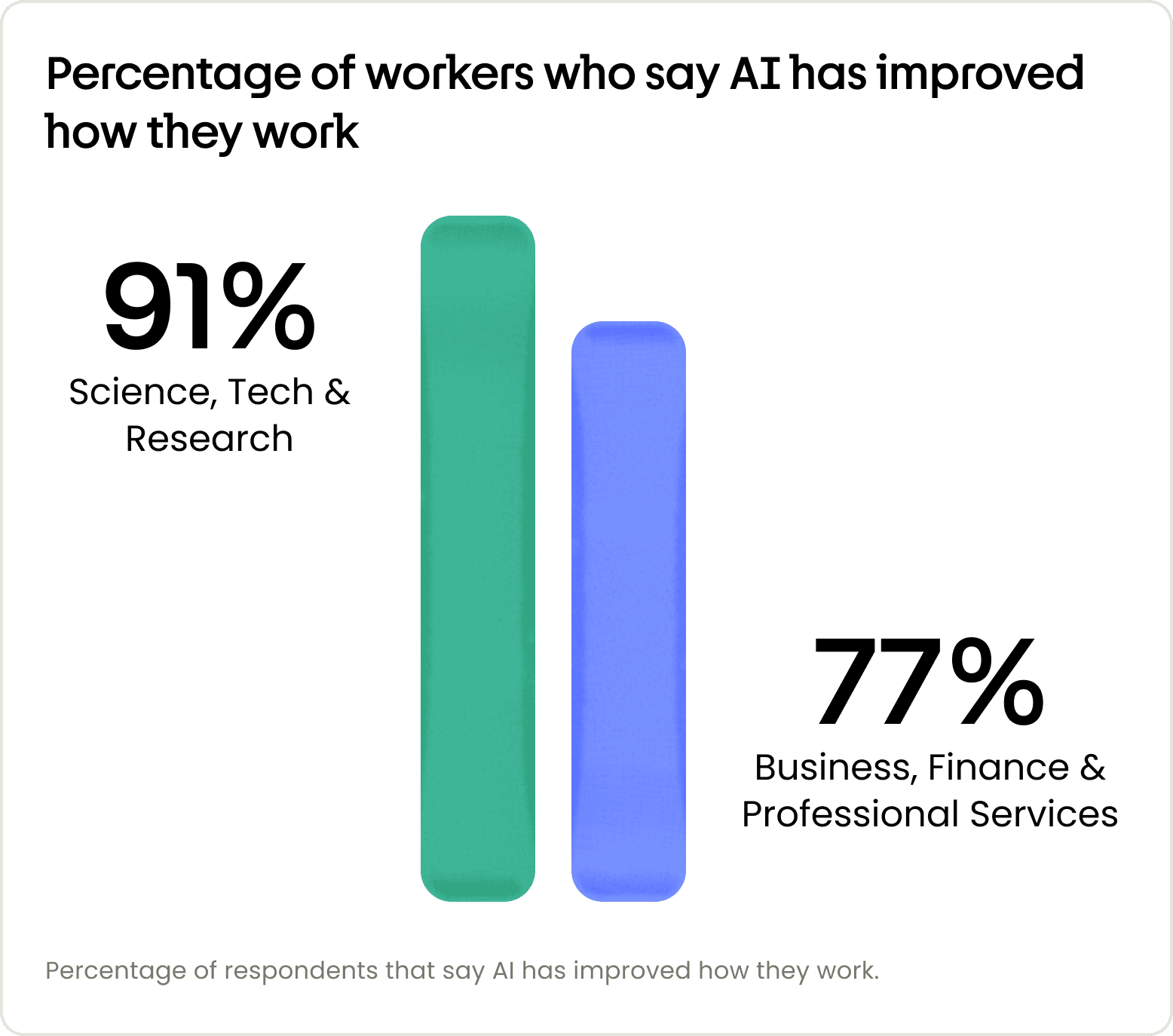
Even with the enablement gap, 74% say AI has improved how they work. Respondents in professional and technical sectors cite the biggest improvements from using AI.
Age, gender and income divide AI usage
Younger workers face the worst admin burden, but they’re using AI to fix it
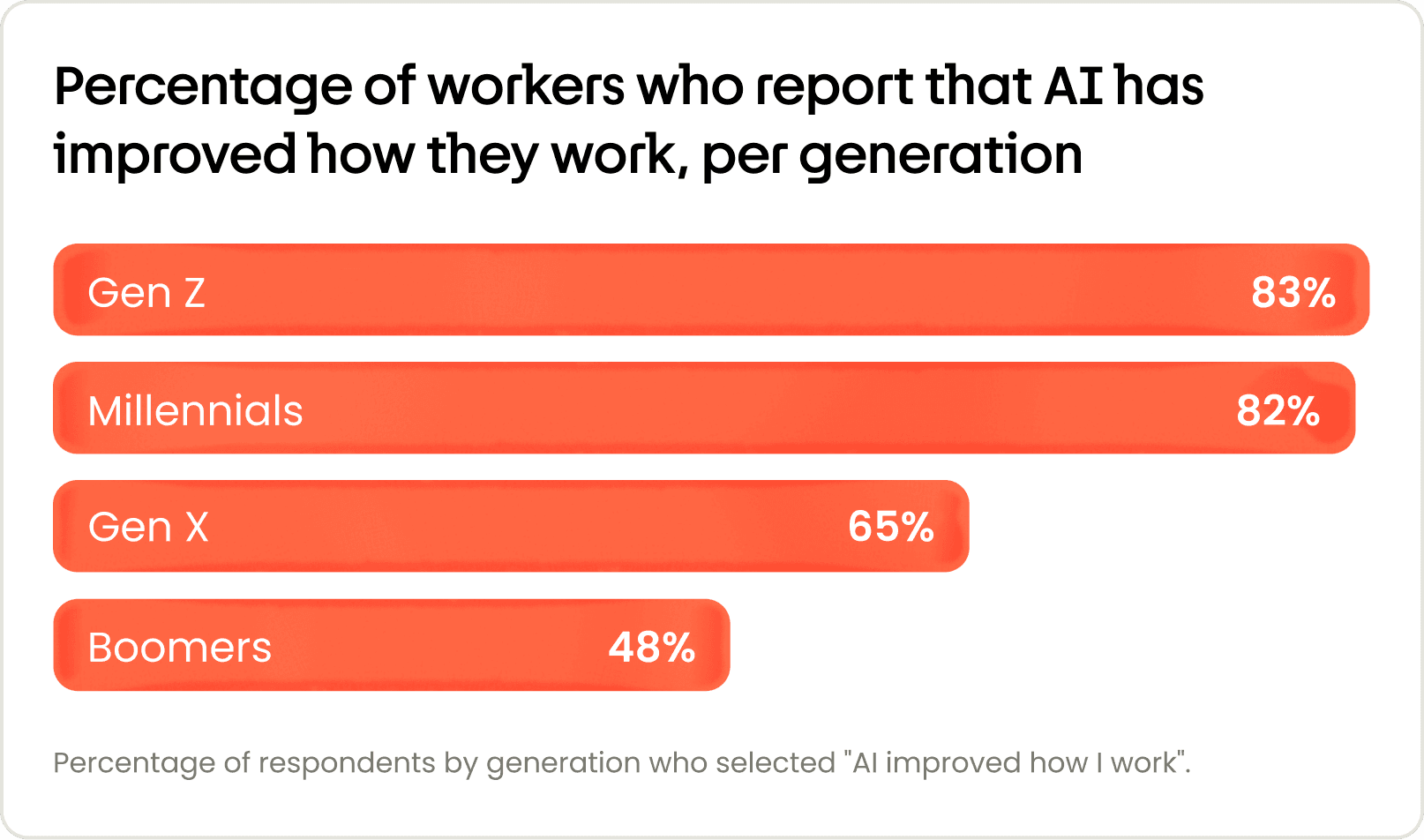
56% of Gen Z report using AI “always” or “often”, compared with only 15% of Boomers. Since younger workers report the highest admin burden, it’s not surprising that they’re actively attempting to close the gap—and experiencing the greatest benefits of AI in the process.
Older generations report enablement gaps, not a suspicion of new AI tools
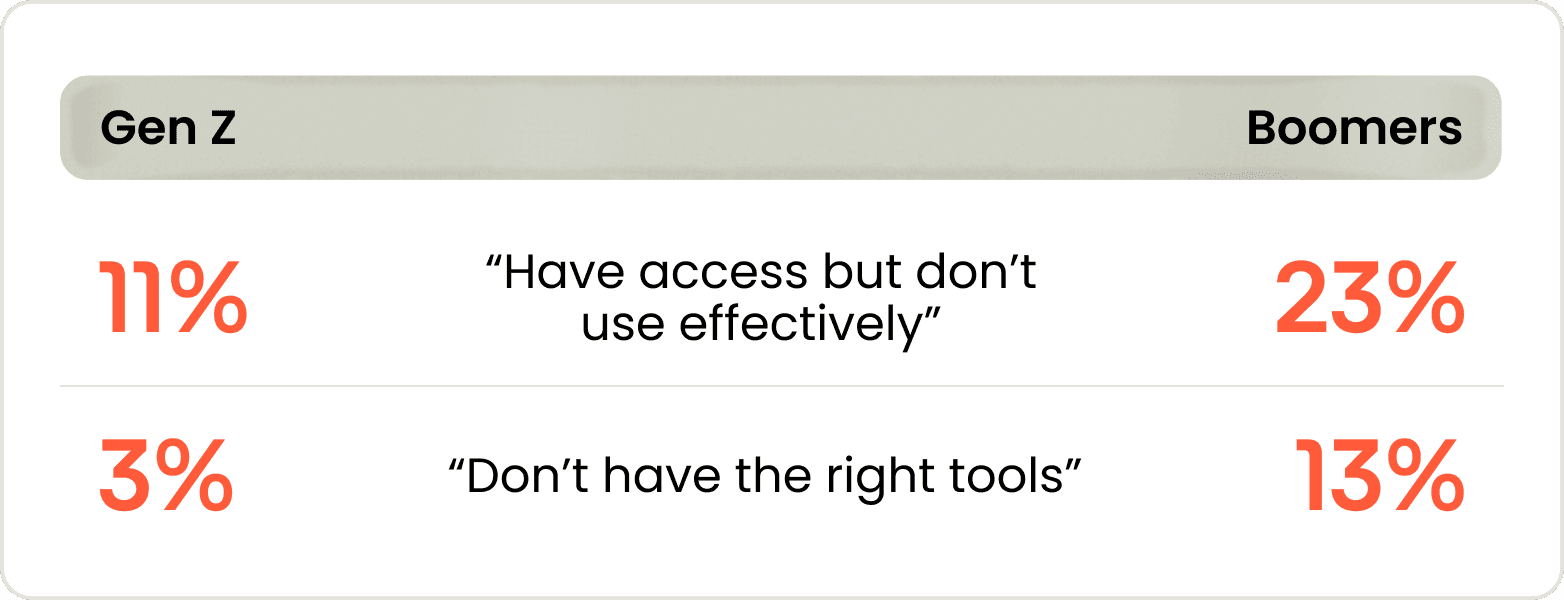
Older cohorts are more likely to say that they don’t have the right tools, or that they do have access to tools but don’t use them effectively. Notably, Boomers are 4× more likely than Gen Z to say they haven’t been given the right AI tools. Outright negative AI sentiment remains a minority view among older generations with fewer than 1 in 10 Gen X or Boomer respondents feeling concerned about AI.
The AI divide follows the pay divide
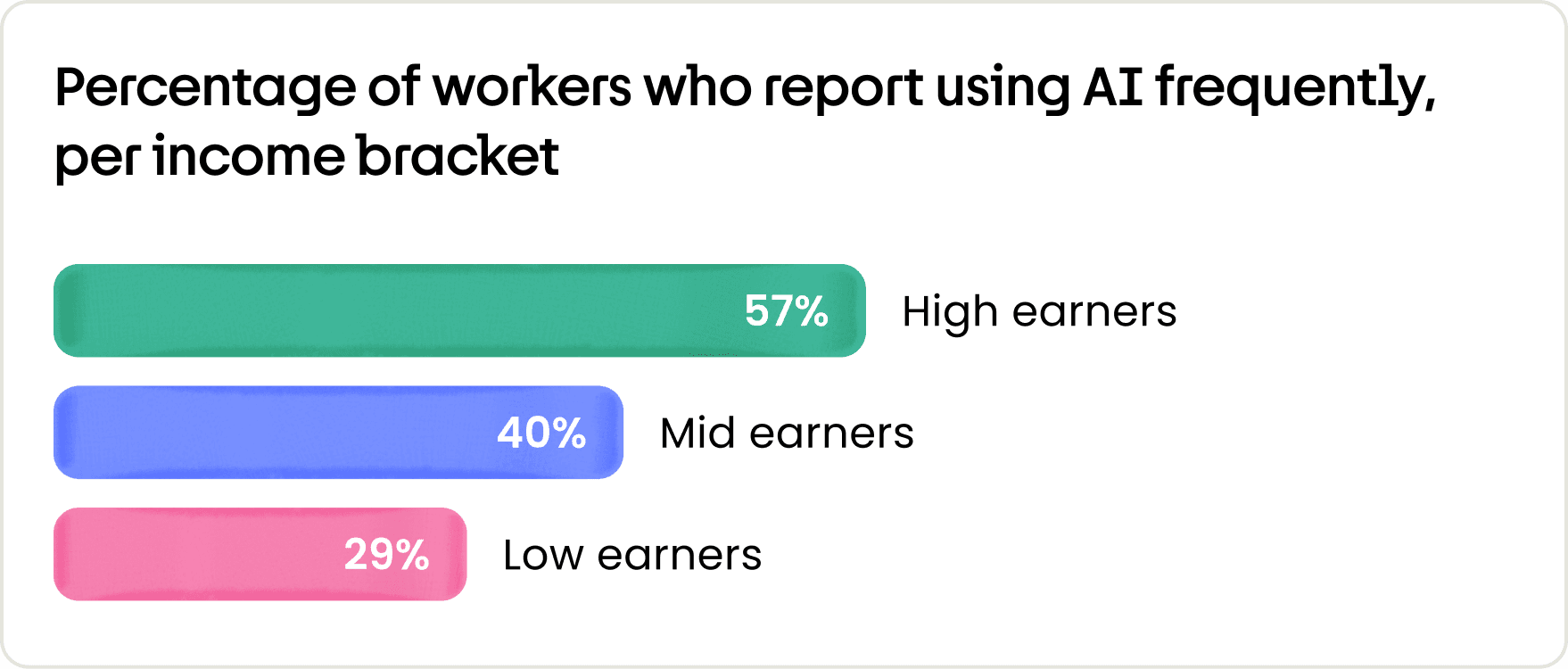
Income predicts AI adoption. High earners use AI at twice the rate of low earners. That usage gap translates directly to a benefit gap: 84% of high earners say AI improved their work, compared with 65% of low earners. Higher earners also report better access, with a greater number feeling “fully equipped” with the AI tools they need.
The AI gender gap is leaving women behind
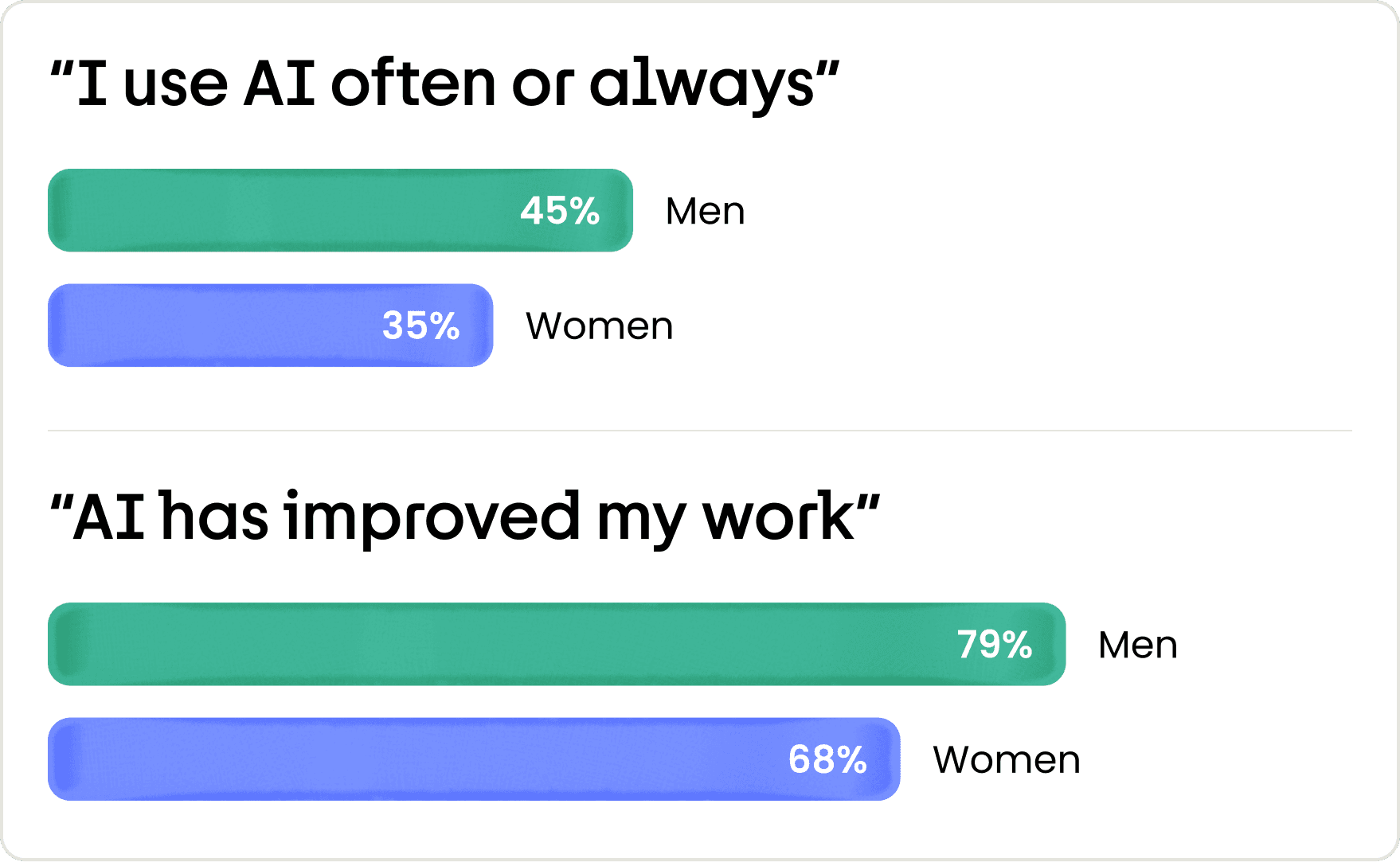
Men use AI more than women. They also benefit more. Outright negative sentiment toward AI is low for both men and women, so the gap isn't driven by distrust or resistance. It's about enablement. Women are more likely than men to say they haven't been given the right tools, or that they have access to AI tools but don't use them effectively. Failing to successfully equip half of the workforce means that organizations are leaving productivity gains on the table.
Summary: The deficit is expensive & unequal, but fixable
The Performance Deficit costs $17k per employee every year
Admin that could be automated continues to consume employee time, drain cash and block productivity gains that AI has already proven it can deliver.
The Deficit isn’t caused by employee resistance
Over 73% are positive about AI. Low adoption reflects weak enablement, not skepticism.
The Deficit is unevenly distributed
2 in 3 employees say their AI tools are insufficient. Productivity gains are concentrated among younger workers, high earners, men and professional or technical sectors—which risks leaving everyone else behind.
Closing the Deficit works
Nearly 75% of AI users say these tools have improved their work, rising above 90% in science, technology and research sectors.
Fixing the deficit
- Treat AI as core productivity infrastructure: To experience the benefits of AI across the full organization it must move beyond optional experimentation at the employee level and instead serve every team.
- Close generational and gender gaps: Minimize the workforce imbalance by deploying trusted tools that offer straightforward workflow integration and provide mandatory AI training.
- Prioritize AI tools that remove daily frictions: Opt for low-risk solutions to repetitive admin problems. Tools that promise abstract innovation will take years to embed and may never close the Deficit.
- Measure success by the deficit you’ve closed: That’s admin removed, time saved, and hours returned to meaningful work.
Move beyond the burden
As the invisible overhead, admin represents systemic inefficiency not poor individual time management. Employees face a tidal wave of low-value, repetitive tasks which displace the core work that drives business growth.
For the first time, The Admin Burden Index has lifted the curtain on the cost of avoidable admin hitting employers: $954 billion each year that doesn’t show up on the balance sheet. That's $17,000 per office worker.
On top of this cost, admin is generating a turnover tax. High earners and younger generations will exit roles if the volume of admin remains unaddressed. But employees aren’t surrendering to their admin burden; 30% are looking for AI solutions to lighten their workload and refocus attention on higher-value work.
Yet the workforce performance deficit persists. Employees of all ages, across industries and income levels, lack the AI tools they need to maximize the impact of their role. For employers, there are three next steps to take.
Three steps for success
- Step 1: Calculate the Invisible Overhead Use Fyxer’s calculator to determine the admin burden cost for your organization.
- Step 2: Track admin time and set measurable targets Monitor the admin burden regularly and set time-saving targets across the business.
- Step 3: Deploy AI tools that reduce the admin load Tackling admin is a low-risk starting point for organizations integrating AI into their workflow. Research trusted tools and gather employee input to eliminate high-volume, low-value tasks.
Methodology
Independent reported data
The Admin Burden Index is built from primary data collected for Fyxer by OnePoll, an independent market research company. OnePoll surveyed 5,000 UK and US office workers, plus 6,000 nationally representative adults, between November and December 2025, to capture:
- Demographic data (age, industry, income)
- Time spent on admin tasks
- Emotional impact of admin
- Attitudes toward AI adoption
To calculate the $954 billion annual cost of avoidable admin, OnePoll surveyed a representative sample of UK and US office workers on annual income and hours spent on AI-addressable admin, then extrapolated this cost across the office worker population of both countries.
Fyxer user insights
The report is supplemented with anonymized behavioral data from Fyxer’s platform and proprietary research, including user interviews and surveys conducted globally throughout 2025.
About Fyxer
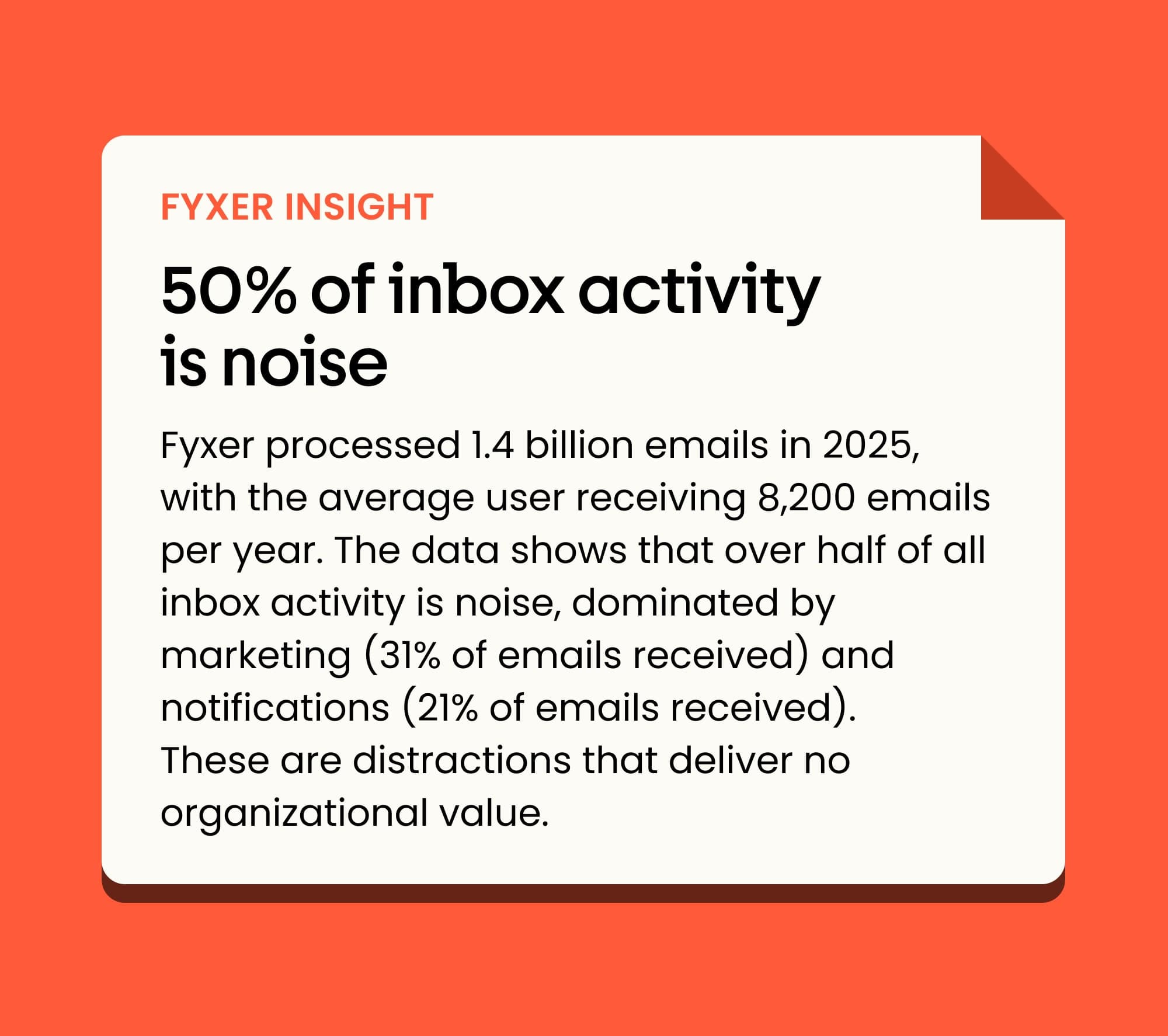
Fyxer is the email assistant that organizes your inbox, writes draft replies and takes actionable meeting notes. Fyxer processed 1.4 billion emails in 2025 and saves users an average of one hour a day on avoidable inbox admin.