
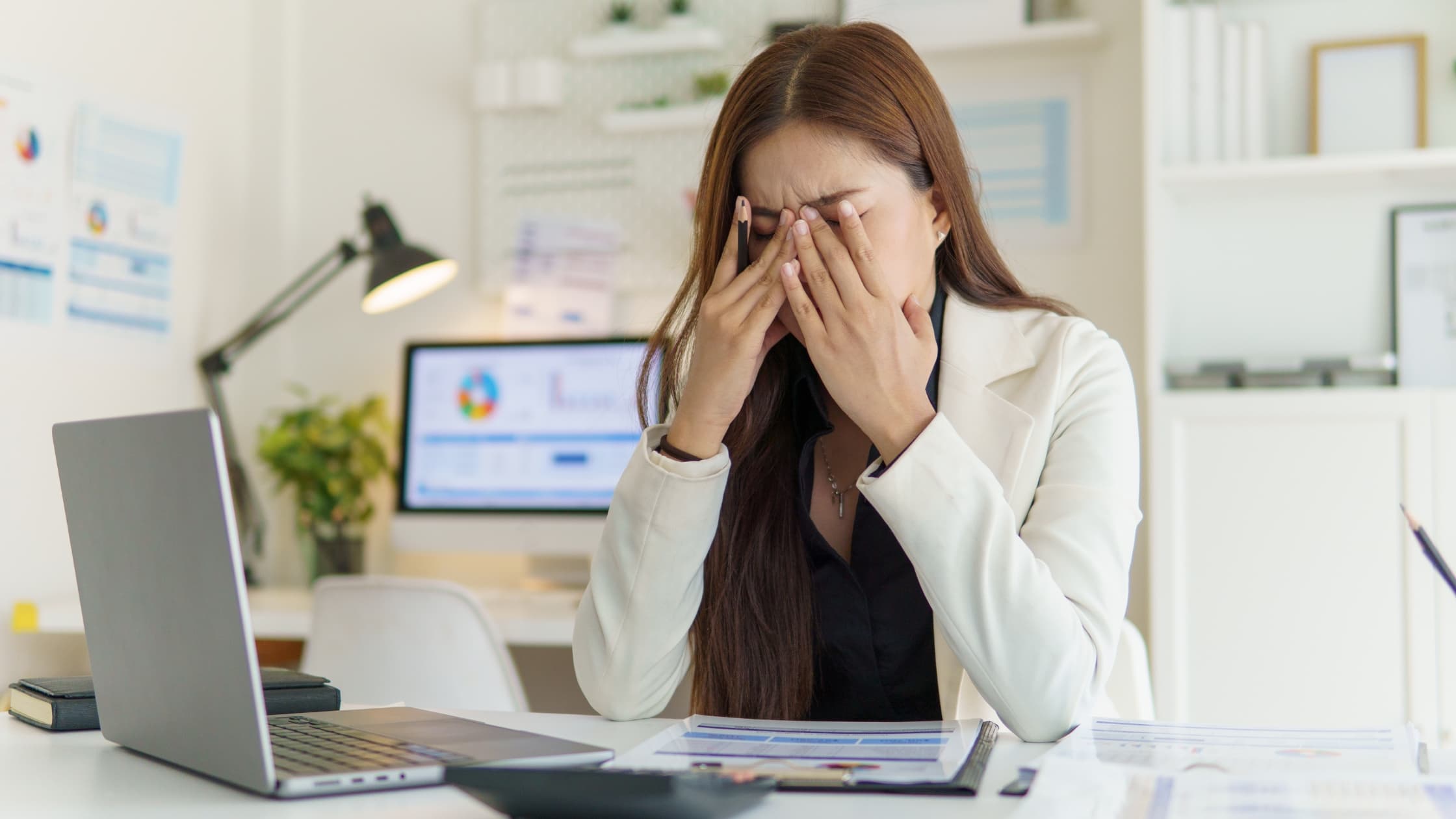
Email anxiety is common. It's the stress response that hits when you open your inbox and feel that knot in your stomach before you've even read a single message. It shows up in high performers, sales reps juggling 50+ threads, and people who genuinely care about doing good work. If you delay replies even when you know they matter, or reread emails trying to decode tone, you're not failing at work. You're responding to a system that blends urgency, authority, and judgment into a single channel.
For many people, email creates a loop that looks like this: delay leads to dread, dread leads to avoidance, avoidance leads to more unread messages, and that volume increases stress from email. The inbox gets louder even when nothing’s actually urgent. Over time, the fear of opening emails grows, not because emails are dangerous, but because they feel emotionally loaded.
Email pulls together tasks, expectations, performance, and relationships. It carries messages from bosses, clients, peers, and strangers. It arrives at all hours. It leaves room for interpretation. And it rarely tells you how quickly you truly need to respond.
For professionals like account managers and sales reps who live in their inbox, this hits differently. When your pipeline depends on fast, clear communication, a backlog of unread messages is a professional liability.
What is email anxiety?
Email anxiety is the emotional and physical stress response tied to receiving, opening, reading, or replying to emails. It often shows up as avoidance, overthinking, or tension rather than panic or fear in the traditional sense.
People describe inbox anxiety in many ways:
- Putting off opening emails for hours or days
- Feeling a spike of stress when a notification appears
- Rereading messages to guess the sender’s intent
- Drafting replies and never sending them
- Feeling guilty about unread messages during evenings or time off
Email anxiety isn’t a formal medical diagnosis. It’s a lived experience that overlaps with stress and anxiety responses recognized by mental health professionals. The Mayo Clinic describes anxiety as a reaction to perceived threat or anticipation, often paired with physical symptoms like muscle tension and racing thoughts. Email fits neatly into that anticipatory stress pattern, especially when messages feel unpredictable or evaluative.
You can experience email anxiety even if you don’t have generalized anxiety. Many people feel calm in meetings and confident in their work, yet struggle with the inbox. That distinction matters. Email anxiety is often situational and system-driven, not a personal flaw.
Graduate students, managers, and freelancers show similar patterns. People who are capable and motivated describe intense stress from email, fear of opening emails from supervisors, and inbox avoidance that affects their confidence. These shared experiences point to a structural problem with modern communication, not individual weakness.
Why do emails stress me out so much?
If you’ve ever asked yourself, “Why do emails make me anxious?”, the answer usually lives in a combination of psychology, workplace norms, and technology design.
Emails imply urgency and evaluation
Most inboxes treat every message the same way. A casual update sits next to a performance review request. Your brain doesn’t know which one’s safe until you open it. That uncertainty triggers anticipatory stress.
Psychologists describe this as threat anticipation. The mind prepares for negative outcomes even without evidence. A study in Nature Reviews Neuroscience showed that anticipation plays a major role in anxiety responses, especially when outcomes feel unclear.
Power dynamics are baked into email
Emails often come from people who can affect your workload, reputation, or income. A short message from a boss or client can feel loaded, even when it is neutral. The absence of tone or facial cues leaves space for interpretation, and anxious minds fill that space with worst-case assumptions.
Volume and unpredictability increase cognitive load
Lifewire reported that the average professional receives over 120 emails per day. Each message represents a decision: reply now, reply later, delegate, ignore, archive. That constant decision-making drains mental energy and increases stress from email, especially when messages arrive throughout the day.
Fyxer data backs this up, too. The average professional receives 29 emails per day requiring a response, according to the Fyxer Admin Burden Index, 2026, a survey of 5,000 UK and US office workers. For 15% of people, that number jumps to more than 51 emails per day. Each message represents a decision: reply now, reply later, delegate, ignore, archive. That constant decision-making drains mental energy and increases stress, especially when messages arrive throughout the day.
Pressure to sound “right” raises the stakes
Email feels permanent. People worry about phrasing, professionalism, and tone. This pressure turns simple replies into performances. Writing becomes harder when expectations feel unspoken but strict.
Together, these factors explain why email overwhelm at work feels intense even when the tasks themselves are manageable.
Common signs of email anxiety
Email anxiety doesn’t always announce itself clearly. It often hides behind habits that feel practical or responsible. Some common signs include:
- Avoiding your inbox for long stretches, even when you have time: You tell yourself you’ll check email later when you feel more prepared. In reality, waiting usually makes the inbox feel heavier, not easier.
- Opening email only when absolutely necessary: You only open your inbox when you expect a specific message or cannot avoid it anymore. This trains your brain to associate email with pressure rather than routine communication.
- Drafting replies repeatedly without sending: You rewrite messages to get the tone exactly right. Each revision raises the stakes and makes hitting send feel harder than it should.
- Feeling tense, nauseated, or restless when thinking about email: Just the idea of opening your inbox triggers a physical stress response. Your body reacts before you’ve even read a single message.
- Checking email during time off and feeling instant guilt: You look “just in case” and immediately feel behind or responsible for replying. Time off stops feeling like rest because email is still mentally present.
- Interpreting neutral messages as criticism: Short or direct emails feel negative even when they’re not. Your mind fills in tone that was never intended.
- Feeling behind even after clearing your inbox: You reach inbox zero but still feel unsettled. The stress comes from anticipation, not the number of emails left.
How do I get over email anxiety?
Reducing email anxiety starts with changing your relationship to email, not forcing yourself to push through discomfort. The aim is to focus on lowering emotional friction rather than increasing output.
Change how you think about email
Email is a communication tool. It’s not a measure of worth or competence. Most messages are informational or logistical. They rarely require perfection.
Silence from others usually means neutral delay, not dissatisfaction. People miss messages, prioritize other work, or respond later. Reframing silence as neutral reduces fear-driven interpretations.
When anxiety shows up, remind yourself that email is asynchronous by design. It allows time and space. Urgency is the exception, not the rule.
Reduce decision fatigue around replies
Every time you open an email and wonder how to respond, you spend mental energy. Decision fatigue increases avoidance.
You can reduce this by setting simple defaults:
- Decide response time expectations once, such as same-day for internal emails and two business days for external ones
- Use templates for common replies so you do not start from scratch
- Set a time limit for drafting emails, such as 5 minutes for routine responses
When decisions are pre-made, email feels lighter.
Create psychological safety in your inbox
Psychological safety means your inbox feels predictable, not like a constant source of interruption or surprise.
Start by setting email-checking windows. Many people find real relief by checking email two or three times a day instead of reacting to every notification. Turning off alerts outside those windows reduces the constant background stress that keeps your nervous system on edge.
Structure matters too. When everything lands in one long list, email feels like an overwhelming barrage. Tools like Fyxer help by categorizing your emails automatically, so messages that need action are separated from FYI updates and noise. When you open your inbox and immediately see what matters, your brain can relax instead of scanning for threats.
Make replies easier than avoidance
Avoidance feels protective in the moment, but it increases anxiety over time. The goal is to make replying feel simpler and lighter than putting it off.
Start by drafting without editing. Get a response down quickly, then refine it if needed. Short, clear emails lower the emotional stakes for both you and the person reading them.
This is where support can make a real difference. Fyxer drafts replies for you in your own tone of voice, so you are not staring at a blank screen or overthinking how to start. You can tweak the draft, send it when you are ready, and move on. The benefit is not speed. It is removing the emotional friction that turns small replies into stressful tasks.
Practical habits that reduce email anxiety over time
Sustainable habits are what turn short-term relief into long-term calm. When email anxiety is high, it’s tempting to look for a single fix, a new rule, or a stricter system. In practice, calm comes from small, repeatable behaviors that make email feel predictable and manageable over time.
- Handle emails once when possible: If an email takes less than 2 minutes to respond to, reply when you open it. If it takes longer, schedule time for it. Leaving emails half-processed increases mental load.
- Triage with intention: When opening your inbox, sort messages into clear categories: needs action, waiting, reference, archive. This gives structure to what might otherwise feel chaotic. If sorting feels like another task on top of the pile, an AI organizer like Fyxer can handle the categorization automatically.
- Write “good enough” emails: Professional emails don’t need to be perfect. Clear, kind, and direct works. Over-editing fuels anxiety and rarely improves outcomes.
- Use clear subject lines and requests: Clear subjects and explicit requests reduce back-and-forth. They also make future emails easier to process.
- Close loops intentionally: End threads with a clear next step or confirmation. Closure reduces lingering mental clutter.
When email anxiety is a sign of something bigger
Sometimes email anxiety points to broader issues.
Burnout increases sensitivity to demands. When energy is low, even small tasks feel heavy. A recent study for Brain Sciences MDPI linked burnout to reduced executive function, which affects decision-making and emotional regulation.
Workload imbalance also matters. If email carries too many responsibilities, anxiety increases. Boundaries and role clarity help.
For some, anxiety about emails reflects generalized anxiety or stress from outside work. If email anxiety interferes with daily life or well-being, mental health support can help.
The important point is this: adjusting systems is more effective than blaming yourself.
Regaining calm and control in your inbox
Learning how to reduce email anxiety is about reclaiming emotional space. Email doesn’t need to dominate your attention or define your worth. With clearer boundaries, simpler habits, and quieter systems, inbox anxiety loosens its grip.
For many people, the biggest relief comes from reducing surprise and decision load. Opening email becomes easier when you know what to expect and when support is already in place. This is where tools like Fyxer can help, by drafting replies in your tone and organizing what matters so facing your inbox takes less out of you.