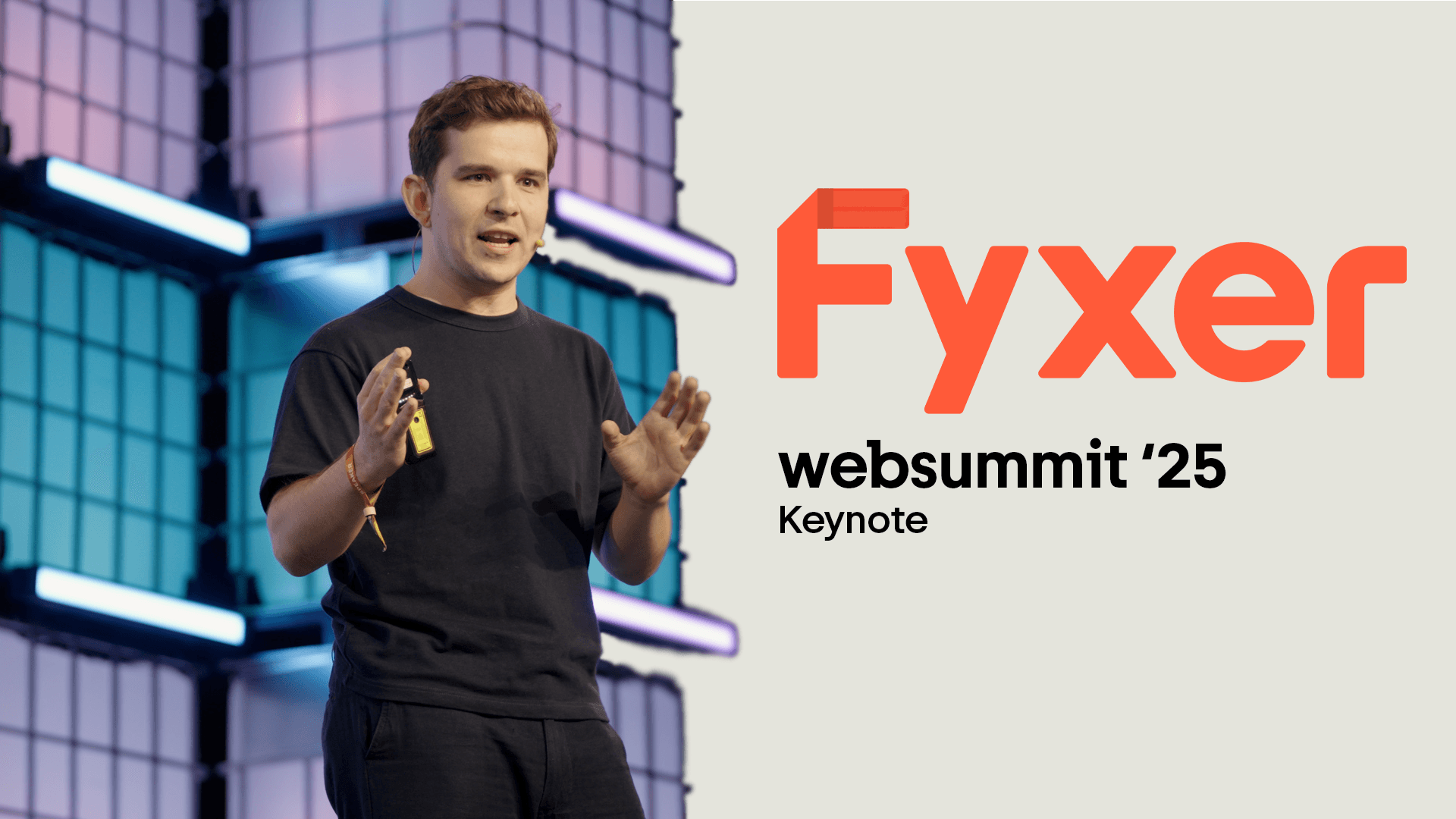
It’s rare for Fyxer Co-founder Archie Hollingsworth to clear his diary and take to the stage. His primary focus is firmly on building Fyxer. When he does deliver a keynote, it’s only because he’s learned something worth sharing.
At Web Summit 2025, Archie proposed that companies racing from $1M to $100M ARR in under two years aren't simply riding the coattails of ChatGPT or Gemini. They're building specialized AI that understands the messy, subjective reality of how humans actually work.
Archie would know. In just 10 months, Fyxer jumped from $1M to $25M ARR. Today, the company adds $1M ARR net new every single week. A year ago, Fyxer had reached $300k ARR and was being built out of time at HF0, a hacker fellowship north of San Francisco that brings together top AI companies to build in focused isolation. Archie met founders working on growing human organs in labs and curing addiction with AI doctors. When he mentioned fixing email, the response was confusion. Surely large AI models have already mastered that?
Watch the full keynote
The subjectivity problem no one wants to solve
AI has conquered objective problems. Code has clear syntax. Math has definitive answers. Protein folding follows predictable patterns. These problems make for impressive research papers and viral demos.
Email is different. As Archie explains, email is one of the most subjective challenges you can hand to AI. It’s personal, it’s contextual and it requires sensitivity. And that's why most companies avoid it.
Consider a simple scenario: someone emails asking if you'd like to speak at their event, who from your team should present, and what the topic should be. Straightforward questions that routinely turn into 20-email threads. Were this code, an AI would find the answer immediately. But email requires understanding a wider context that doesn't exist in the message itself.
"When you're trying to predict what someone might do, you need to teach the AI the sort of strange behaviors that we humans have, the subtleties that have happened over evolution, the subtleties of context, of tone. The AI needs to be able to read the room."
– Archie Hollingsworth, Co-founder of Fyxer
This is why ChatGPT struggles with your inbox. General-purpose models weren't trained on the specific communication patterns of professionals who spend three hours daily managing messages. They don't know your Friday afternoon response to a client sounds different from your Monday morning reply to a teammate. They can help you draft an email if you feed them enough context, but they can't predict what you need to write before you even open the message.
That gap between assistance and prediction is where real productivity lives. And it's why the fastest-growing AI companies are building their own models instead of relying on foundation models to do the work.
UI can be copied overnight, AI can’t
"In our quiet corner of London, we've been developing the models ourselves. Relying on base models is proving to be where the downfall happens because AGI is not suddenly around the corner. The era of context engineering is upon us, and specialization matters."
That specialization is why Fyxer ranks #7 on Andreessen Horowitz's list of where AI startups are spending, sitting alongside Cursor, ElevenLabs, Anthropic, and OpenAI. Not because Fyxer has more funding or a bigger team, but because the company invested in building AI that deeply understands a specific problem: how professionals communicate.
The pattern repeats across high-growth AI companies. Cursor, the AI coding tool now valued at nearly $40 billion, doesn't try to reinvent how developers write software. It accelerates the workflow they already have. Engineers using Cursor report that code prediction is the feature they value most. Their process hasn't changed. They're just faster in every single minute they're working.
Archie notes that UI can be copied overnight. But the hardest problem, and the hardest thing to copy, is your AI. This is the insight most AI products miss. The value isn't in the interface. It's not in the chat experience or the feature list. It's in training models that understand domain-specific patterns, context, and nuance.
AI innovation must fit inside existing workflows
The companies building AI businesses that will last aren't asking users to change how they work. They're making existing work easier.
Archie was direct about Fyxer's approach:
"We've taken our ego out of it. We're not going to invent anything yet. We're going to copy exactly how people work today."
That might sound uninspiring compared to promises of revolutionizing productivity or reinventing work. But it's why 90% of Fyxer users stay after three months. The product works inside Gmail and Outlook. It drafts replies in your tone. It organizes your inbox using familiar categories. Nothing about your day changes except the time you save.
As Forbes noted, this approach to product-led growth is what drove Fyxer's explosive trajectory. When you save someone an hour every day without them needing to learn anything new, they tell people. The product becomes its own growth engine because it solves a real problem without asking users to change their behavior.
Compare that to general AI assistants, which require constant context switching. You leave your inbox, open ChatGPT, explain what you need, review multiple options, copy the result, paste it back into your email, and edit it to sound like you. The friction compounds with every message until you’re left wondering why you didn’t write the email yourself.
"Chat is not necessarily the best way to interact with AI in every single task you're doing. The thing with short-form content like email is that you're battling with the user just doing the work themselves. If you ask them to go through multiple options, to review lots of things, to chat with it, they might as well have done it themselves."
Prediction changes the equation. When AI has already done 60-70% of the work and you simply add your touch, the tool becomes faster than doing it manually. That's when adoption sticks. When usage becomes habitual, a product moves from interesting to indispensable.
Fyxer now counts over 240,000 inboxes organized and has written more than 109 million email replies. That scale didn't come from traditional enterprise sales. It came from individual professionals finding value and bringing their teams along.
Why Big Tech isn't always the answer
The most common question Archie hears: Why won't Google or Microsoft just build this? They have more resources, more data, more engineers. How could a startup from London compete against trillion-dollar companies?
"A bigger model, or a smarter person, doesn't necessarily do a better job. Would you rather have an executive assistant who’s known you for 20 years and absorbed everything about your working style, or do you want an MIT math grad?"
As Forbes puts it, “While tech giants like Google are focused on juggling the needs of billions of users, Fyxer AI is laser-focused on power users who treat email as their professional weapon of choice.”
The hardest problem isn't building a bigger or smarter model. It's building a model that understands humans. That learns tone, priorities, and communication style. That knows the difference between an email requiring a two-sentence reply and one needing a thoughtful three-paragraph response.
Specialization requires training AI on specific workflows, communication patterns, and decision-making processes. It takes thousands of hours of human feedback teaching models the subjective judgments that make communication work.
Trust compounds over time in ways raw intelligence cannot. An executive assistant who has worked with you for 20 years knows what you're thinking before you say it. They draft the email you would have written. They understand the subtext in a client request and know how you'd want to respond.
That's the standard AI needs to meet. Not impressive demos or clever features, but genuinely understanding how a specific person works.
The real measure of success
Archie closed his Web Summit talk with a story about Mike, a construction operations manager in the Midwest who spends his days on the road managing projects and teams. When Mike gets home, he faces an inbox full of messages that need responses.
Mike told Fyxer CEO, Richard, that the product had saved him from a divorce. Those two hours every night he used to spend hunched over his computer answering emails? He got them back. Time with his family instead of time managing his inbox.
That's the real test of whether AI is working. Not how smart the model is or how impressive the technology sounds, but whether it gives people back time to do work that actually matters.
You may also be interested in:
Building Europe's global tech edge: why London beats Silicon Valley
Fyxer Ranks #7 in AI Application Spending - ahead of Perplexity and Lovable